Hivernacle
Walk beneath the iron-and-glass roof of Barcelona’s restored 1888 glasshouse, then explore the living plant collection in the Magnòlies wing.
01 / The experience
Hivernacle
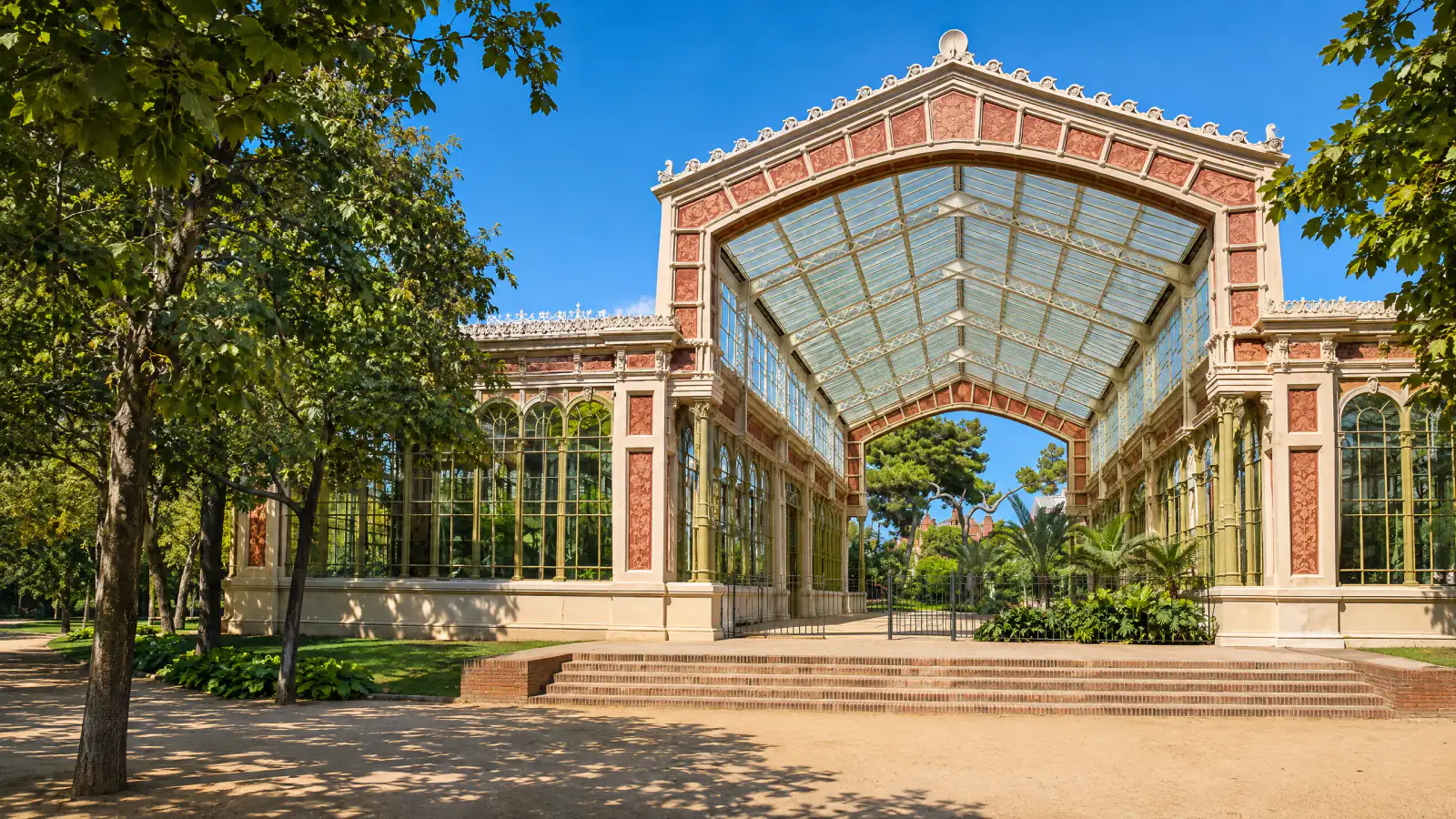
From the park path, the Hivernacle looks like three roofs at different heights. Climb the shallow steps and you are in a covered crossing with the park in sight through the far end. The glass above is held in a fine grid of iron, while the sheltered wings to either side have repeated arches and red and cream decoration. Josep Amargós i Samaranch designed the greenhouse for the Barcelona Universal Exposition of 1888. It gave the new park a place to grow and display plants, a job it has taken up again more than a century later.
The restored ironwork and decoration
Restoration brought back the building’s nineteenth-century appearance and revealed work by Alexandre de Riquer i Ynglada, a Catalan Modernista artist. Stand near the base of a column and look up along the row of arched windows. There is a band of ornament where the brick and painted iron meet, and the roof structure reads quite differently from this side than it does against the sky from the park. The glasshouse reopened in December 2023 and became part of Barcelona’s Natural Sciences Museum in January 2025.
The living collection in Nau Magnòlies
The Nau Magnòlies houses the permanent living collection. At path level the beds are set low enough to see through to the taller plants, where palm fronds and broad leaves reach across the window grid. The arched end wall gives the path a clear focal point. The collection includes more than a hundred plant species, with smaller flowering plants filling the beds below the taller foliage. Since this is a living collection, the plants in flower will change throughout the year.
Nau Picasso and the central crossing
The central nave introduces the park’s scientific buildings. Across the crossing, the Nau Picasso is used for changing exhibitions, talks and other nature programmes. The two wings have different roles, even though their architecture echoes across the central passage. On a brief stop, the Magnòlies wing and the covered crossing give the clearest sense of the Hivernacle as both a working glasshouse and a building from the exposition.
The science buildings next door
A few steps farther along the same edge of the park, Centre Martorell d’Exposicions fills the city’s original public museum with temporary science exhibitions. The old glasshouse and the stone museum can be visited from the same park path. Look north towards the brick Castell dels Tres Dragons and you can see another of the buildings that have kept the park’s nineteenth-century architecture in everyday use.
04 / Before you go
Plan your visit
Admission
- Self-guided walk-in
- Free
- Optional guided visit
- Free with advance reservation
Opening hours
Daily 10:00–20:00. Closed 25 December and 1 January.
See opening hoursGetting there
Passeig de Picasso, 7, 08003 Barcelona
Take metro L1 to Arc de Triomf and walk down Passeig de Lluís Companys into Parc de la Ciutadella. Follow the Passeig de Picasso side past Castell dels Tres Dragons to the glasshouse at No. 7. From Jaume I on L4, walk east through El Born to the park.
Tickets and entry
Walk in free for a self-guided visit. Guide dogs are welcome. Pets stay outside.
The free 50-minute guided visit has advance reservations, with any remaining places offered on the day. The museum lists Catalan sessions on Thursday, Sunday and public holidays and Spanish sessions on Saturday. Check its programme for dates and reservations.
Location & nearby places
Continue exploring
More around Ciutadella
Good to know
Hivernacle: frequently asked questions
Do I need to book to visit the Hivernacle in Barcelona’s Parc de la Ciutadella?
The Hivernacle in Barcelona’s Parc de la Ciutadella has free walk-in admission for self-guided visits. Reserve a place for the optional free guided visit.
What is in the two wings of the Hivernacle in Barcelona’s Parc de la Ciutadella?
At the Hivernacle in Barcelona’s Parc de la Ciutadella, Nau Magnòlies houses the living plant collection and Nau Picasso hosts changing exhibitions and activities.