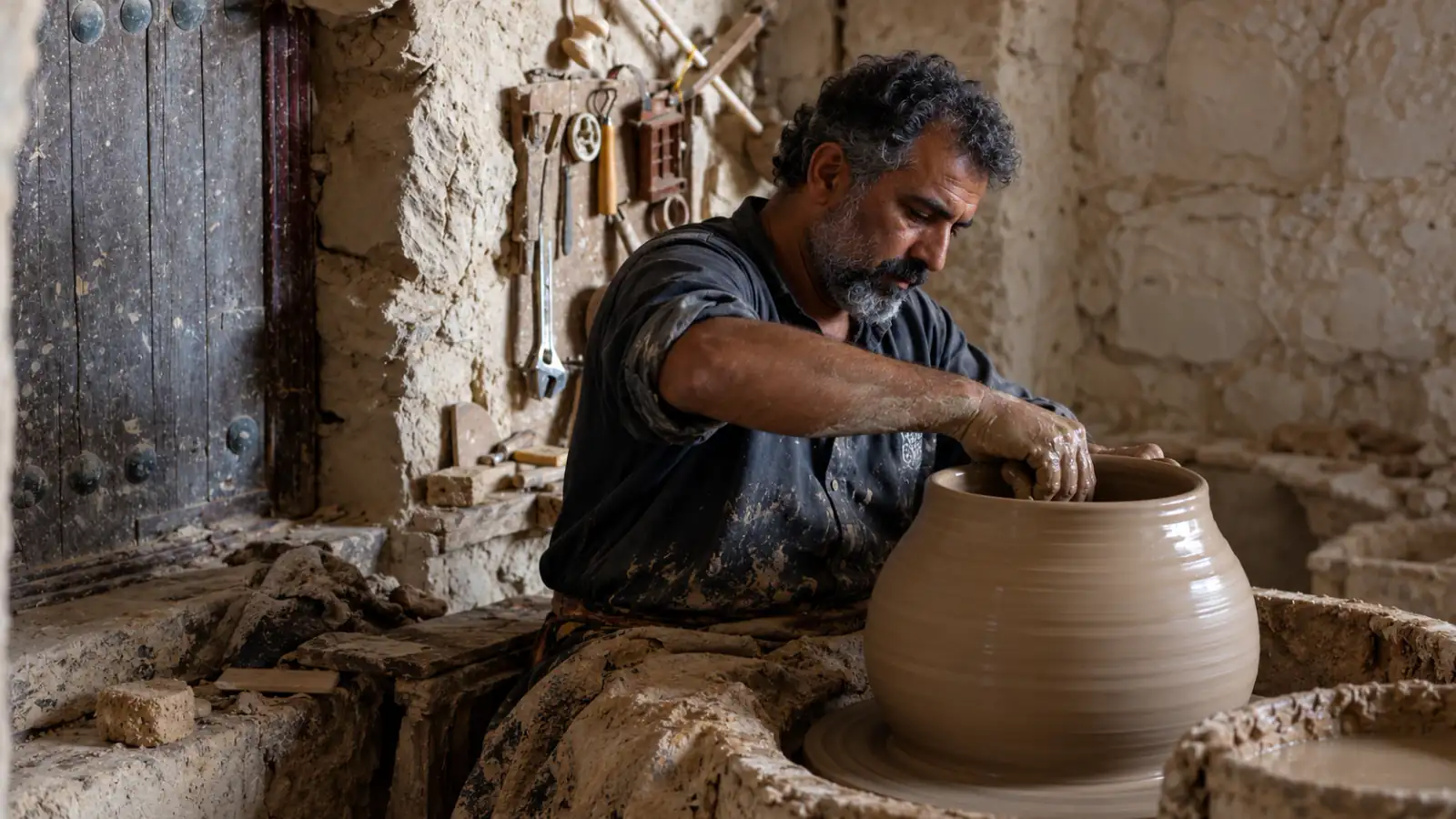
A’ali pottery at Al-Shughul Workshop
Watch vessels take shape at the wheel, browse A’ali-made ceramics and arrange a hands-on pottery or painting session at Al-Shughul.
01 / The experience
Clay preparation, a foot-powered wheel and a family craft.
Watch vessels take shape at the wheel, browse A’ali-made ceramics and arrange a hands-on pottery or painting session at Al-Shughul.
A foot-powered wheel gives Al-Shughul’s pottery its starting point. The potter turns a large lower wheel with the feet while shaping clay on the smaller surface above. The mechanism joins two very different tasks: maintaining rotation below and controlling the vessel’s wall and rim by hand. A small vase can emerge from a compact lump, while a large jar demands a different scale of handling.
This is a family craft as well as a technique. In a Reuters interview in 2022, Mohammed Al Shughul described learning from his father and producing both decorative pieces and everyday vessels at the Jaffar Al Shughul workshop. An earlier account interviewed Jaffer Mohammed Al Shughul about learning as a child, with relatives continuing his training after his father’s death. Those accounts describe knowledge acquired through work within the family, rather than a craft reconstructed solely for demonstrations.
There is considerable work before clay reaches the wheel. The earlier workshop account describes selecting and mixing clay, soaking and filtering it, then working it to remove trapped air. Freshly formed vessels dried in shade before firing. That sequence helps explain the unfired pieces and finished stock as different stages of production. The historical account also records changing kiln technology; it should not be read as a timetable for seeing a firing during an ordinary visit.
The shapes connect pottery to Bahraini domestic life. Water-storage jars, drinking vessels and containers for preparing food gave the craft practical purposes long before decorative ceramics became a major part of its range. The al-habb water jar is a particularly clear example of adaptation: an older form can be fitted with a tap or retained as a decorative object. Bahrain Tourism also identifies the manakhidah, a vessel associated with making yogurt, among the traditional household forms.
The showroom brings the range into the present. Cups, plates, vases, incense burners and money boxes sit within a craft that now makes pieces for homes and gifts as well as traditional uses. Finished surfaces differ from raw clay, and painted decoration gives familiar forms another character. A purchased vessel can be selected for use or appearance; for anything intended for food or drink, ask the maker about the particular piece’s suitability and care.
A’ali’s burial landscape is part of the workshop’s setting. The Culture Authority records pottery installations developing around the mounds and historical use of burial chambers as kilns. This relationship belongs to the history of the village’s working landscape. It does not make a modern pot an archaeological object or turn a workshop visit into access to protected tombs. The National Museum’s pottery and trades displays offer a useful companion, while the mound fields have their own access arrangements.
At Al-Shughul, visitors can arrange pottery making or painting under artisan guidance. These are different ways to engage with the material: forming a vessel and decorating one involve different stages. The activity, age suitability, duration and collection arrangements need to be agreed with the workshop. A pot newly shaped at the wheel still has drying and firing ahead of it; a short visit therefore needs a clear plan for what can be taken home and when.
04 / Before you go
Plan your visit
Watch vessels take shape at the wheel, browse A’ali-made ceramics and arrange a hands-on pottery or painting session at Al-Shughul.
Prices
Session price by enquiry
Workshop session price by enquiry. Ceramics are priced individually; ask about materials, firing and collection for a making session.
Visiting hours
Saturday–Thursday 08:00–18:00 in the tourism listing; closed Friday. Hands-on sessions are arranged separately.
Getting there
Al-Shughul Pottery Workshop, Highway 71, A’ali, Bahrain
Plan your visit
Call Al-Shughul to arrange pottery making or painting, including the time, party size, participant ages, price and any firing or collection arrangements.
Accessibility
The workshop includes working areas and display aisles. Ask about level access, seating and a suitable working position before arranging a hands-on session.
Location & nearby places
Continue exploring / Bahrain
More to explore
in Bahrain
Find another place for your itinerary, or explore all things to do in Bahrain.
 Bahraini & casual diningJasmi’s in Zayed TownExplore experience →
 Bahraini & casual diningSameeh Pastries & Restaurant in RiffaExplore experience →
 Cafés & bakeriesCrème at Al Liwan, HamalaExplore experience →
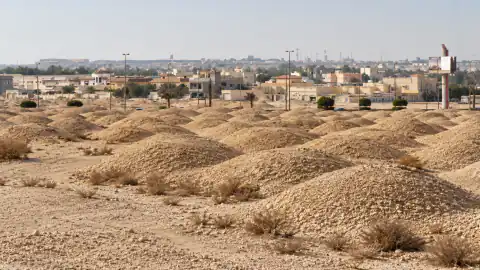 Cultural districtsDilmun Burial Mounds at A’aliExplore experience →
Good to know
A’ali pottery at Al-Shughul Workshop: frequently asked questions
Where is Al-Shughul Pottery Workshop in A’ali, Bahrain?
Al-Shughul Pottery Workshop is on Highway 71 in A’ali, Bahrain, and is also listed as A’ali Pottery Workshop–Alshugel Pottery. Contact the workshop on +973 3985 6994 for arrival instructions.
Can visitors try pottery making or painting at Al-Shughul in A’ali?
The workshop offers pottery making and painting. Arrange the activity and price directly, including any age requirements and the time needed.
Can I take home a pot made at Al-Shughul on the same day?
Ask about drying, firing and collection before choosing a session. The workshop will explain what can be taken home and whether a later collection is needed.
Does an Al-Shughul pottery visit include access to A’ali’s Dilmun Burial Mounds?
An Al-Shughul pottery session does not include archaeological access to A’ali’s Dilmun Burial Mounds. Arrange the burial-landscape visit separately through heritage visitor information.
How does the traditional foot-powered pottery wheel work at Al-Shughul in A’ali?
At Al-Shughul Workshop in A’ali, the potter turns a large lower wheel with the feet while shaping clay on the smaller surface above. A vertical connection transfers rotation between the two, leaving the hands free to form the vessel.
How is clay prepared before pottery is formed at Al-Shughul?
An earlier Al-Shughul workshop account describes selecting, mixing, soaking and filtering clay, then working it to remove trapped air. Shaping, drying and firing are separate production stages; visitors need an arranged session to see the stages available that day.
Can visitors watch a kiln firing or enter a burial-chamber kiln at Al-Shughul?
Historical accounts describe A’ali potters using mound chambers as kilns and later changes in kiln technology. A present-day kiln demonstration is not confirmed, and a pottery visit does not authorise entry to protected burial chambers.
Are ceramics bought at Al-Shughul suitable for food and drink?
Ask Al-Shughul about the specific vessel’s food-contact suitability and care. The workshop produces decorative pieces as well as household forms, so appearance alone does not establish the intended use.