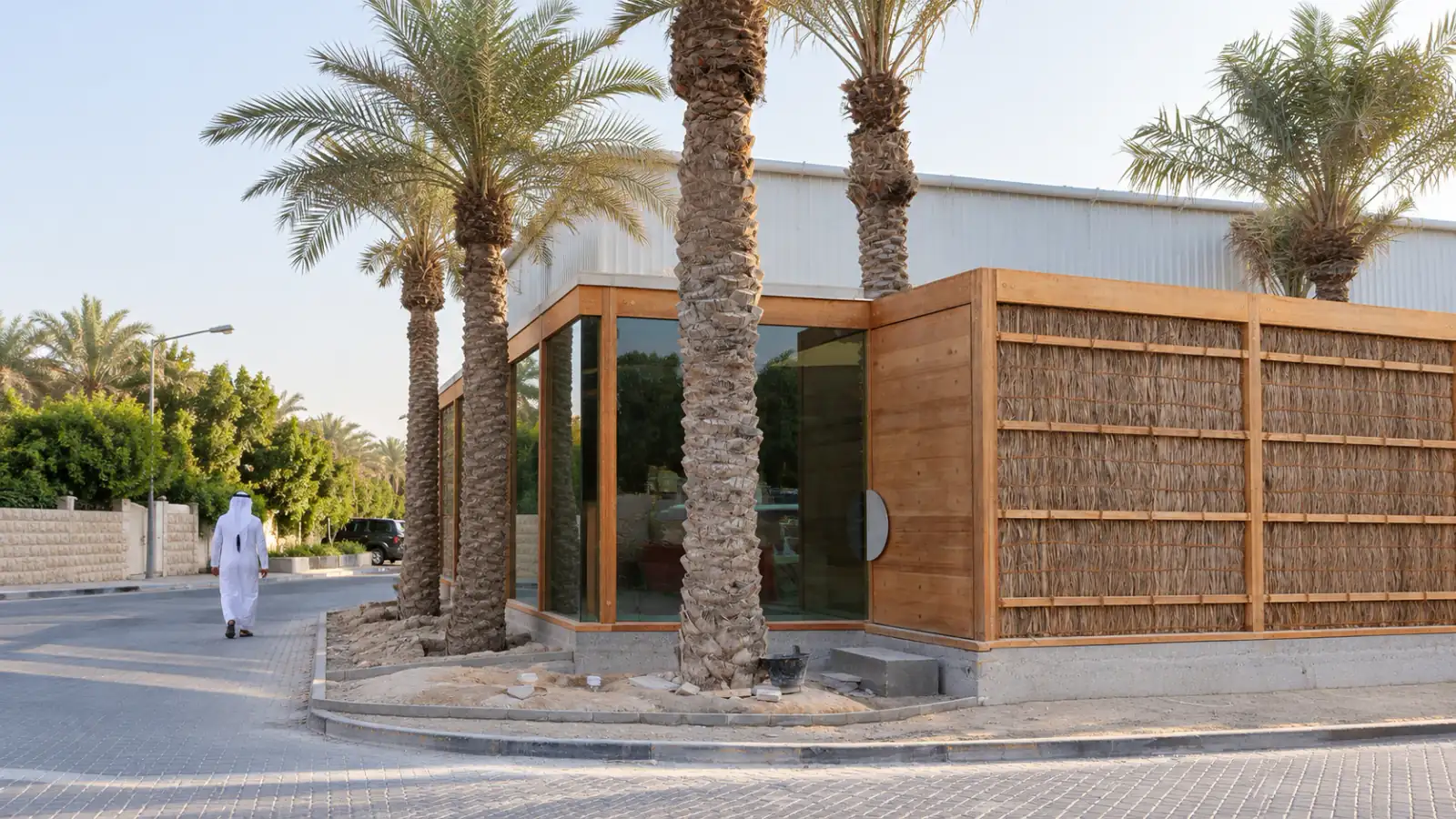
Bani Jamra weaving at Al Naseej Factory
See traditional weaving in a palm-shaded timber building, where loom pits, gardens and a small shop connect Bahrain’s textile craft with village life.
01 / The experience
The loom, the cloth and the building around them.
See traditional weaving in a palm-shaded timber building, where loom pits, gardens and a small shop connect Bahrain’s textile craft with village life.
At Bani Jamra, the position of the weaver explains the building. The artisan sits with legs below floor level, facing a wooden loom whose threads stretch across the working area. Hands and feet work together to turn those threads into cloth. The pits are part of that working arrangement: the surrounding surface provides room for the long, tensioned threads, while the maker operates the loom from below it.
The two sets of thread have different jobs. The warp runs along the length of the cloth; the weft crosses it. In a 2022 interview, weaver Mohammed Abdulredha described preparing and arranging the long threads before weaving could begin. That preparation is substantial work in its own right. At a working loom, the forming cloth is only one part of the process; the stretched threads explain how much has to be set up before a finished textile appears.
The resulting fabrics have a history in everyday clothing. Bahrain’s traditional weavers made lengths for the wezar, worn around the waist by men, and the irdeh, a black women’s outer garment with red and gold lines. Scarves and other products extend that range. The shop gives the cloth another context after the loom: something to wear, use or give, with colour, pattern and intended use shaping the choice. Stock and commissions depend on the makers’ work.
Al Naseej’s architecture takes the craft seriously. Commissioned by the Bahrain Authority for Culture and Antiquities and designed by Leopold Banchini Architects, the facility opened in December 2020. A low grid of timber columns and beams holds woven palm-leaf panels, glass and timber enclosures. This recalls Arish, the palm-leaf construction that shaded earlier working spaces. Above the floor’s recesses, palms rise through the roof; water, planting and seating interrupt the regular grid. The architect conceived a social place for the village alongside the textile workshop.
There are two kinds of weaving to notice here. Cloth takes shape at the loom, while dried palm leaves form parts of the shelter around it. Their materials and purposes differ, but both turn repeated elements into a larger surface. The small scale of the building makes those connections unusually legible: the work, the shade and the places to sit occupy the same setting.
The people practising the craft are also working with contemporary artists. Albareh Art Space documented master weaver Habib Mohammed Saleh and artists developing loom work in September 2026, including Mhairi Boyle at Bani Jamra. That collaboration shows a tradition used to make new work, alongside inherited garment forms. The project’s gallery sessions took place in Adliya as well as at the factory; it was a dated collaboration rather than a standing drop-in class.
A visit can take in the loom areas, architecture and textiles available to buy. Seeing weaving underway depends on artisan attendance, and participation needs an agreed session. From the visitor side of the loom, the most revealing view is the relationship between the maker’s hands, the threads and the cloth already woven. Keep clear of the tensioned threads and recessed working areas; staff can indicate a suitable viewing position.
04 / Before you go
Plan your visit
See traditional weaving in a palm-shaded timber building, where loom pits, gardens and a small shop connect Bahrain’s textile craft with village life.
Prices
Visit arrangements by enquiry
Ask the factory about visit and workshop charges. Shop purchases are priced individually.
Visiting hours
Saturday–Thursday 08:00–13:00 and 16:00–18:00; closed Friday. Artisan attendance and teaching sessions vary.
Getting there
Bani Jamra Weaving Textiles Factory, 6F76+744, Bani Jamra, Bahrain
Plan your visit
Call the factory to arrange an artisan demonstration, group visit or teaching session. Ask for the session time, price and participant requirements before reserving a class.
Accessibility
The building has changes in level and recessed loom areas. Ask about a level route and an accessible viewing position; do not enter working pits without staff guidance.
Location & nearby places
Continue exploring / Bahrain
More to explore
in Bahrain
Find another place for your itinerary, or explore all things to do in Bahrain.
 Public beachesAbu Subh BeachExplore experience →
 Public beachesBudaiya Public BeachExplore experience →
 Restaurants & fine diningVilla Mamas restaurant in Saar, BahrainExplore experience →
 Cultural districtsBudaiya Farmers’ MarketExplore experience →
Good to know
Bani Jamra weaving at Al Naseej Factory: frequently asked questions
What can visitors see at Al Naseej weaving factory in Bani Jamra?
Al Naseej in Bani Jamra is a weaving facility and social space for craftspeople, with teaching spaces and a shop. The work visible during a visit depends on which artisans are present.
Can visitors book a weaving class at Al Naseej in Bani Jamra?
Ask Al Naseej Textile Factory in Bani Jamra about a dated weaving class through its official contact page. A general factory visit does not reserve an instructor or a working place at a loom.
Why are the looms at Bani Jamra’s Al Naseej factory set below floor level?
The pits at Bani Jamra’s Al Naseej factory relate to the traditional seated position of weavers, with their legs below the surface and the loom’s threads extending across the working area.
What are Al Naseej weaving factory’s opening hours in Bani Jamra?
Al Naseej lists Saturday–Thursday 08:00–13:00 and 16:00–18:00, with Friday closure. Contact the factory for the afternoon visit window and artisan attendance before travelling.
What are warp and weft in Bani Jamra’s traditional handloom weaving?
At a Bani Jamra loom, the warp threads run along the length of the cloth and the weft crosses them. Preparing and tensioning the long threads comes before weaving the fabric.
Which traditional Bahraini garments were made from Bani Jamra’s woven cloth?
Bani Jamra’s traditional weavers produced cloth for the men’s wezar, worn around the waist, and the women’s irdeh, a black outer garment with red and gold lines. Scarves and other products extend the range; current stock varies.
Who designed Al Naseej Textile Factory in Bani Jamra, and why does it use palm leaves?
Leopold Banchini Architects designed Al Naseej for the Bahrain Authority for Culture and Antiquities. Woven palm-leaf panels recall Arish construction, which shaded earlier working spaces; recessed floor areas accommodate the traditional seated loom arrangement.
Can I see Habib Mohammed Saleh weaving at Al Naseej during my Bahrain visit?
Albareh Art Space documented Habib Mohammed Saleh’s work with artists in 2026. A particular artisan’s attendance or a demonstration at Al Naseej must be arranged with the factory; the dated collaboration is not a standing public class.