Basilica Cistern — Yerebatan Sarnıcı
Walk among marble columns, brick vaults and the reused Medusa heads in Istanbul’s great sixth-century underground reservoir.
01 / The experience
A Byzantine reservoir beneath the Historic Peninsula
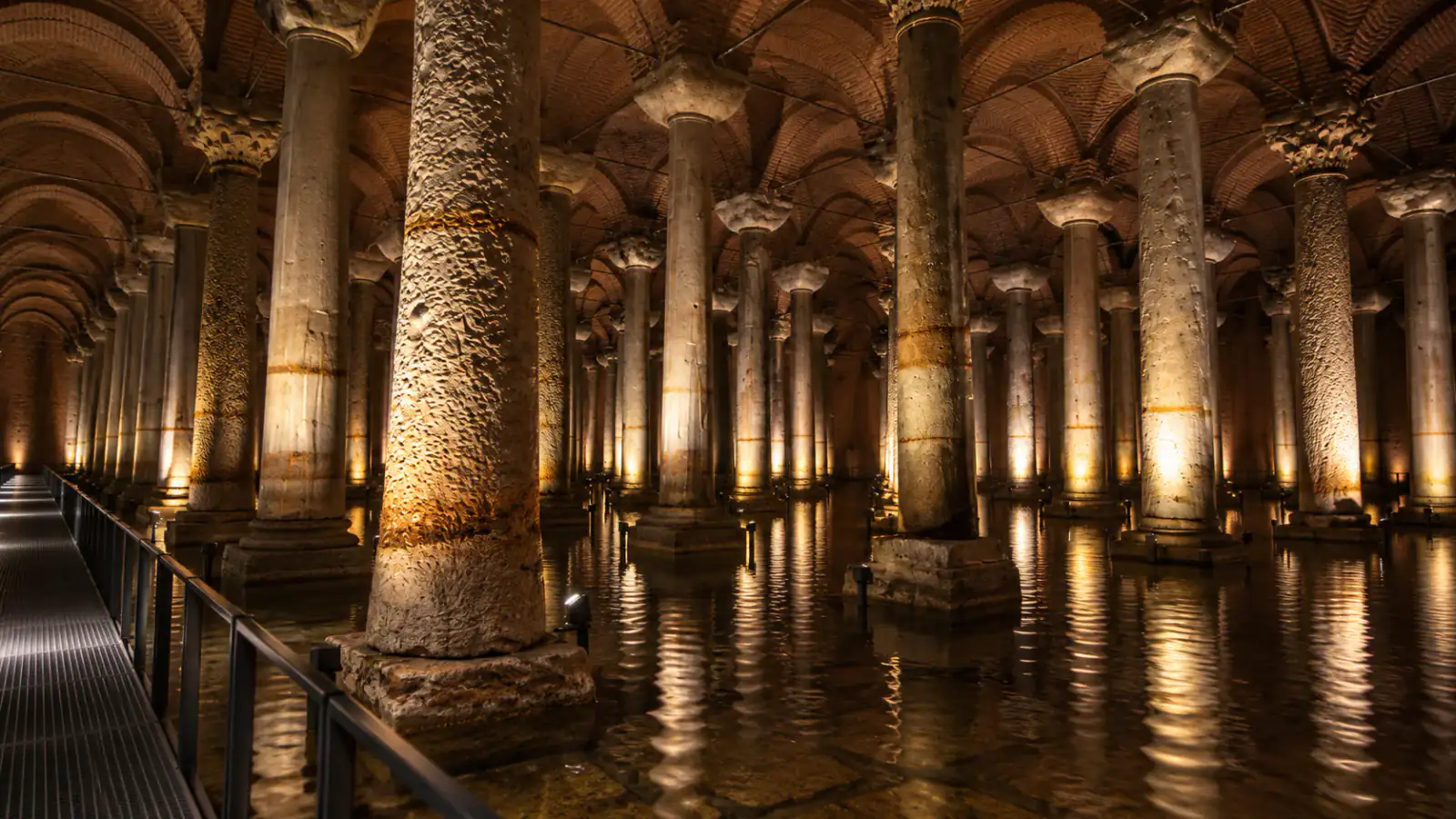
The Basilica Cistern reveals the infrastructure beneath imperial Istanbul. Its brick vaults rest on a grid of 336 columns, with shallow water reflecting the shafts and the low light. The repetition creates the impression of an underground hall, although its original purpose was practical: storing water for the city above.
The reservoir dates to the reign of Justinian in the sixth century. Its name refers to a basilica that once stood in the area, rather than to the building’s use as a church. The scale of the structure makes the demands of the imperial capital tangible. Water storage had to work alongside the aqueducts and channels bringing supplies into Constantinople, sustaining a city whose needs extended well beyond its monumental public buildings.
The columns are not identical. Reused stone, different capitals and changes in surface detail interrupt the regular grid. One patterned shaft is commonly called the Weeping Column, its repeated eye-like motifs standing out from the plainer marble nearby. The modern metal walkways make it possible to see those differences while moving above the reservoir floor and water.
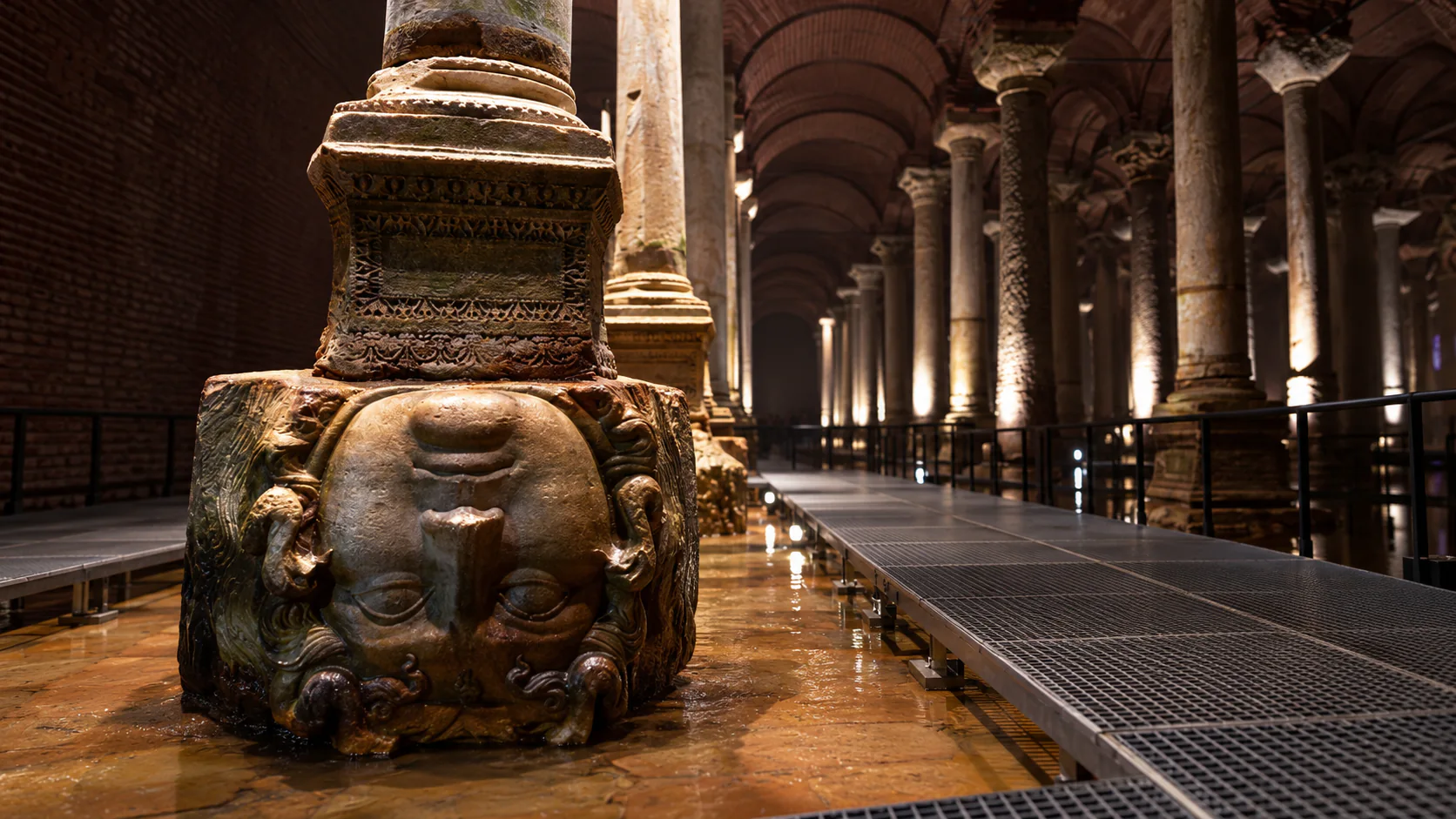
The two Medusa heads used as column bases are the best-known reused pieces. Their faces belong to an earlier sculptural world, brought into a later structure as building material. One is inverted and the other lies on its side. The reason for their exact placement is uncertain; the surviving carvings are more compelling than a legend presented as fact. Their weathered surfaces and unusual orientation make them a distinct part of the visit rather than another repeated shaft.
A major restoration completed in 2022 introduced the current walkway and lighting setting. Illumination changes the appearance of the stone and reflections, so the atmosphere varies across the route. Low light, enclosed space and wet surfaces are practical parts of the experience. The site’s admission arrangements changed in 2026; obtain the current visiting hours and ticket conditions before making a timed plan around it.
Highlights
- 01
336-column underground reservoir
- 02
Medusa heads and patterned column
- 03
Current admission by enquiry
04 / Before you go
Plan your visit to Basilica Cistern — Yerebatan Sarnıcı
Admission and fare
Current admission tariff by enquiry
Request the current visitor tariff and included admission before purchasing.
Visiting times
Request the current opening, last-admission and any evening-session hours from the responsible heritage authority before travelling.
Arrival
Alemdar Mahallesi, Yerebatan Caddesi No.1/3, Sultanahmet, Fatih, Istanbul
The cistern is beneath Yerebatan Caddesi near Hagia Sophia. Use the signed Basilica Cistern entrance at No.1/3. The pin represents the reservoir site, not a temporary queue position.
Admission and enquiries
Contact VGM’s Istanbul regional office for current visitor-access guidance. This is an authority enquiry, not a ticket reservation.
The 2026 operator transition means older municipal tariffs and Night Shift programmes should not be used to price or time this visit.
A new agency ticket portal is for registered travel businesses, not individual travellers. No retail checkout or future admission availability is claimed here.
Request current child concessions, payment methods, cancellation terms and accessible-entry arrangements with the admission enquiry.
Accessibility
The underground Basilica Cistern visit involves low light, steps, metal walkways and potentially damp surfaces. Request the current lift or assisted-entry arrangement and usable internal route before travelling.
Location & nearby places
Continue exploring / Istanbul and Türkiye
More to explore
in Istanbul and Türkiye
Find another place for your itinerary, or explore all things to do in Istanbul and Türkiye.
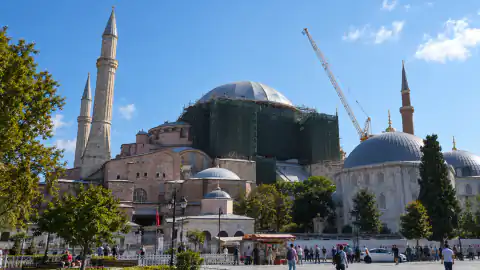 01Landmarks & heritageHagia Sophia visitor galleryExplore experience →
 02Art, craft & culturePaper marbling at Les Arts TurcsExplore experience →
 03Lokantas, köfte & regional foodTarihi Sultanahmet Köftecisi Selim UstaFood price level 2 of 4Regional TurkishExplore experience →
 04Contemporary Turkish tasting menusLokanta1741Food price level 4 of 4TurkishExplore experience →
06 / Good to know
Basilica Cistern — Yerebatan Sarnıcı: frequently asked questions
01What does admission to Basilica Cistern — Yerebatan Sarnıcı include?
Request the current Basilica Cistern admission tariff. Contact VGM’s Istanbul regional office for current visitor-access guidance. This is an authority enquiry, not a ticket reservation.
02When can I visit Basilica Cistern — Yerebatan Sarnıcı?
Request the current Basilica Cistern opening, last-admission and any evening-session hours from the responsible heritage authority before travelling.
03How do I find the entrance to Basilica Cistern — Yerebatan Sarnıcı?
Basilica Cistern is beneath Yerebatan Caddesi near Hagia Sophia. Use the signed Basilica Cistern entrance at No.1/3. The pin represents the reservoir site, not a temporary queue position.
04What are the main access limits at Basilica Cistern — Yerebatan Sarnıcı?
The underground visit to Basilica Cistern involves low light, steps, metal walkways and potentially damp surfaces. Request the current lift or assisted-entry arrangement and usable internal route before travelling.
05How do I arrange admission to Basilica Cistern — Yerebatan Sarnıcı?
The 2026 Basilica Cistern operator transition means older municipal tariffs and Night Shift programmes should not be used to price or time this visit. Request current child concessions, payment methods, cancellation terms and accessible-entry arrangements with the admission enquiry.