Coulée verte René-Dumont
A former railway becomes a walk through elevated gardens, bridges, tunnels and wooded cuttings across eastern Paris.
01 / The experience
Follow the old railway above and below the streets.
The Coulée verte changes level as it crosses eastern Paris. Near Bastille, the planted route runs above the street on the old railway viaduct. Further east, bridges, tunnels and wooded cuttings create a more enclosed landscape. That change is the reason to think of it as a route rather than a single garden: a short walk and a complete crossing reveal different parts of the same former railway.
The former railway and the Viaduc des Arts
The line once linked Bastille with La Varenne–Saint-Maur. After railway use ended, the landscape project kept its structures and introduced a succession of planted spaces. The route extends for roughly 4.5 kilometres towards the eastern edge of Paris, with gardens including Hector-Malot, Reuilly and Charles-Péguy along the wider sequence. Stonework, retaining walls and the alignment of the paths still make the railway history legible.
Along avenue Daumesnil, the elevated section offers views of buildings that are difficult to see in the same way from street level. Below, the Viaduc des Arts occupies the former railway arches with craft workshops. The two levels give the same structure different uses: planted promenade above, working spaces and street frontage below. The workshops are individual businesses, so the walk does not depend on every one being open.
Wooded cuttings and choosing a walking section
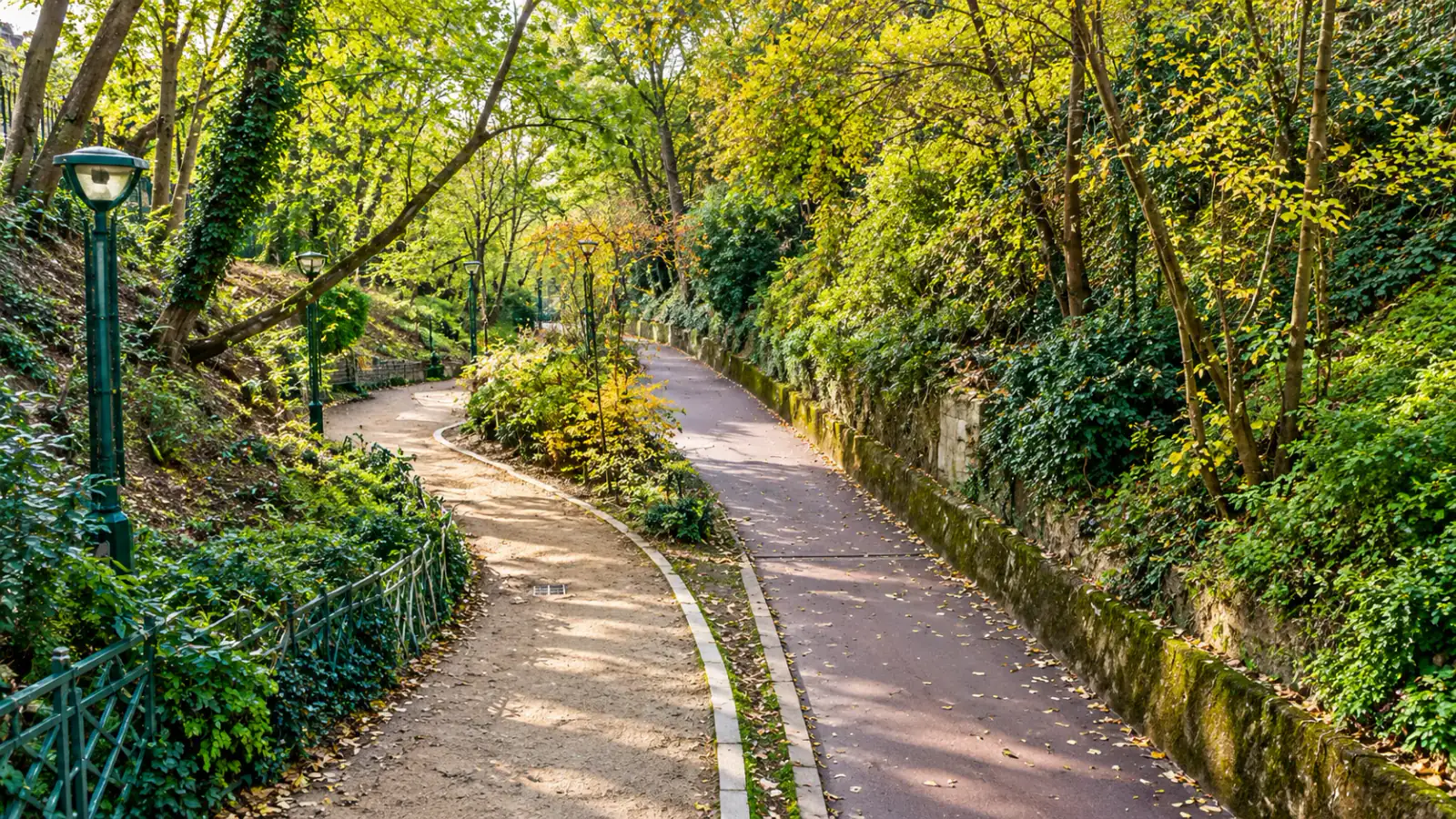
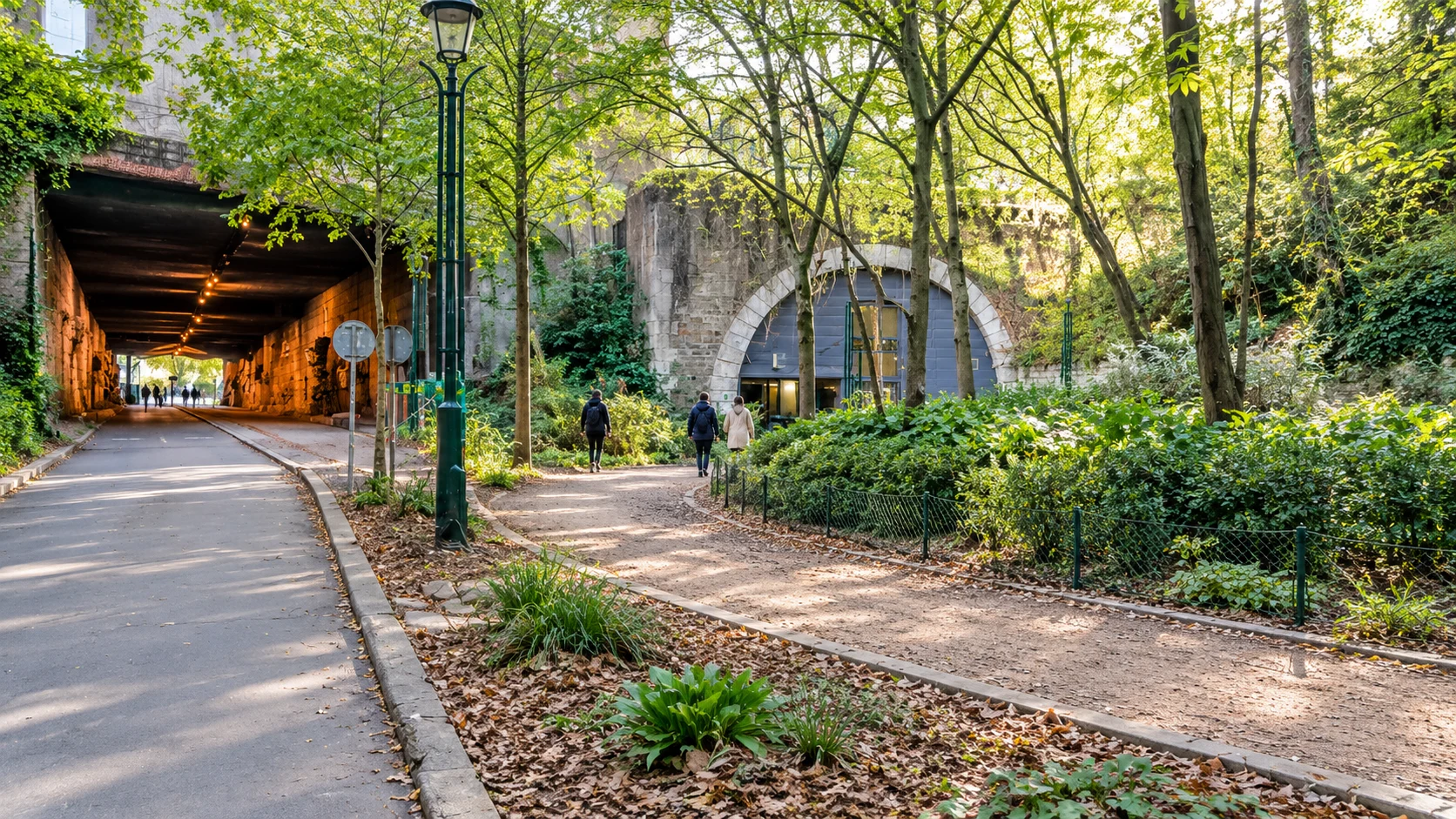
The eastern stretches have another character. Paths pass through cuttings, mature planting and underpasses, with separated pedestrian and cycling routes in parts of the corridor. Green railings, stone walls and changes in width make these sections feel quite different from the viaduct. These wooded stretches lie beyond the short Bastille section.
A return walk from the western end is the simplest version to fit beside a Bastille lunch. The full route is a longer outing with different public-transport options at its far end. Accessibility needs more care than the word promenade might suggest: the route changes level and depends on particular lifts. The municipality currently reports the 34 rue de Lyon lift out of service and the Hector-Malot lift in service. That distinction changes the starting point for anyone avoiding stairs.
In pictures
The full gallery.
02 / The essentials
Coulée verte René-Dumont: visit essentials
- 01
Bastille & the 12th arrondissement
- 02
Allow 60–90 minutes for a shorter out-and-back; 2 hours or more for the full 4.5 km route
- 03
May–August: 08:00–21:30 weekdays; 09:00–21:30 weekends under the current municipal timetable. Closures can apply in severe weather.
04 / Before you go
Plan your visit
A former railway becomes a walk through elevated gardens, bridges, tunnels and wooded cuttings across eastern Paris.
Admission
Public promenade: free entry.
Check admissionChoose your visit
May–August: 08:00–21:30 weekdays; 09:00–21:30 weekends under the current municipal timetable. Closures can apply in severe weather.
Confirm opening and service times for your visit.
Arrival & access
For the Bastille end, approach avenue Daumesnil from Bastille (Métro 1, 5 and 8). The pin marks the listed access at 34 rue de Lyon, whose lift is currently out of service; use the Hector-Malot approach for an operational lift when available.
Bastille end: avenue Daumesnil; access point at 34 rue de Lyon, 75012 Paris
The route has stairs, slopes and lift-dependent sections. The municipality currently reports lifts at 34 rue de Lyon and near Leroy Merlin out of service, and the Hector-Malot lift in service. Check the municipal lift notice before a step-free visit.
Plan admission
Free public promenade; no reservation is required. Craft workshops beneath the viaduct have their own opening and admission arrangements.
05 / Where it is
Find it
and what’s nearby.
Continue exploring
More of Paris, around your visit.
06 / Good to know
Coulée verte René-Dumont: frequently asked questions
01How long is the Coulée verte René-Dumont?
The full Coulée verte René-Dumont route is about 4.5 kilometres. It links the Bastille side with eastern Paris through a sequence of gardens, bridges, tunnels and former railway cuttings.
02Where can I join the Coulée verte René-Dumont near Bastille?
The western approach to the Coulée verte René-Dumont includes 34 rue de Lyon. This entrance has stairs and a lift, but the lift is currently reported out of service.
03Is the whole Coulée verte René-Dumont above street level?
No. Its western section follows the elevated viaduct above avenue Daumesnil, while later sections pass over bridges and through tunnels, cuttings and ground-level gardens.
04Is the Coulée verte René-Dumont free, and when does it open in summer?
The promenade is free. May–August garden hours are 08:00–21:30 on weekdays and 09:00–21:30 at weekends; weather, maintenance or safety closures can change access.
05Can I use a lift to reach the Coulée verte René-Dumont?
Hector-Malot provides lift access to the promenade. The lifts at 34 rue de Lyon and near Leroy Merlin are out of service. Lift availability can change before your visit.
06Does the Coulée verte René-Dumont have water and toilets?
Drinking-water points and toilets are available along the Coulée verte René-Dumont. They are distributed along the route, rather than provided at every entrance.
07What is the Viaduc des Arts beneath the Coulée verte René-Dumont?
The Viaduc des Arts occupies seventy-one arches beneath the avenue Daumesnil section, with craft workshops and studios. Workshop visits follow each business’s opening arrangements.