01 / The experience
The city behind the shop windows.
Cast-iron streets, loft-era art spaces and shops south of Houston Street.
The city behind the shop windows.
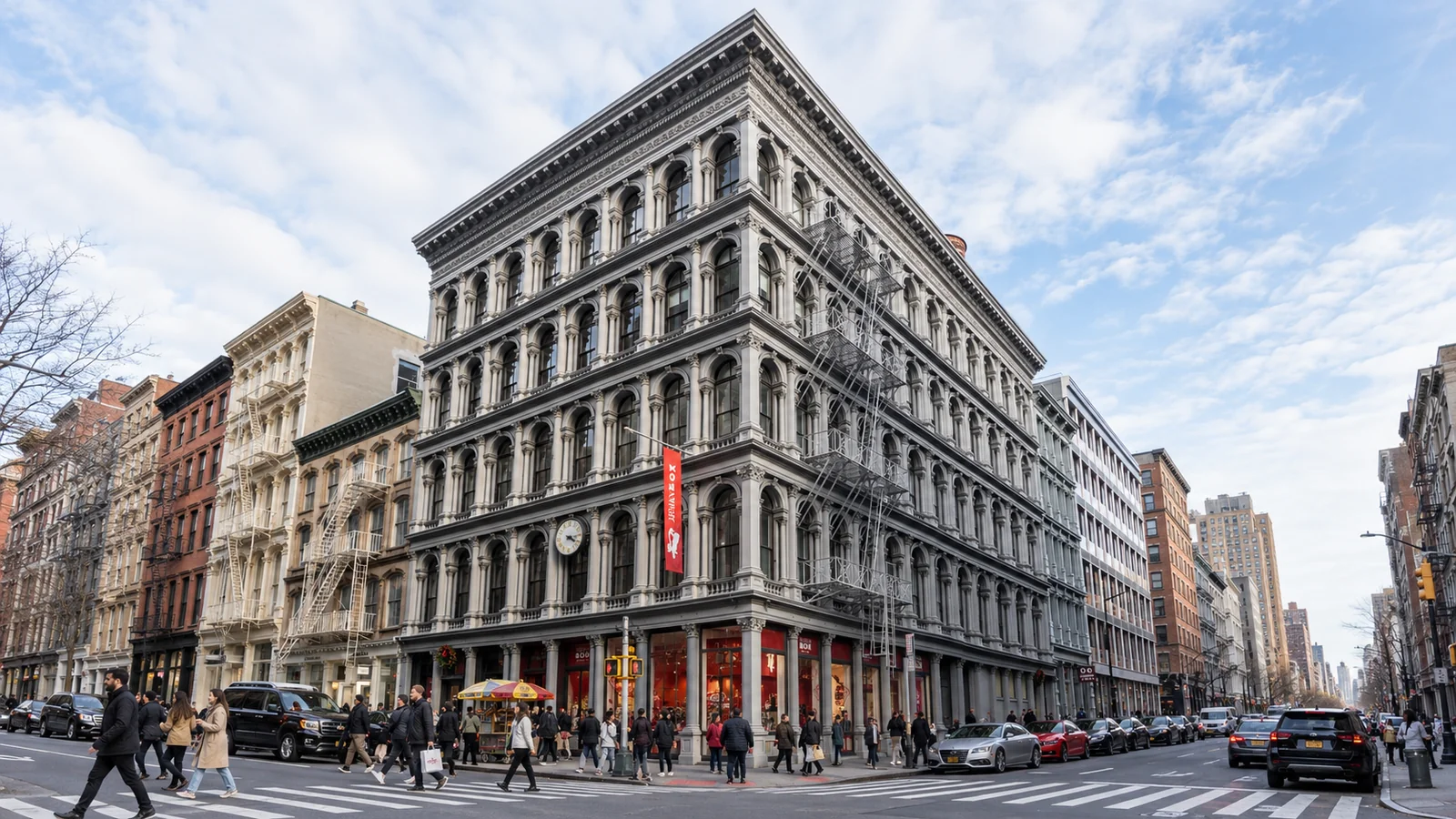
SoHo makes a shopping street into an architectural walk. Above the windows, rows of iron columns support arches, balustrades and elaborate cornices. The repetition gives whole blocks a shared rhythm, but the buildings reward closer comparison: one façade is almost lace-like, another uses broad square openings, and a surviving brick house interrupts the taller lofts. Broadway carries much of the commercial bustle; Greene, Mercer and Wooster streets reveal the district at a smaller scale.
At Broadway and Broome Street, the Haughwout Building provides a memorable starting point. Its five-storey cast-iron front wraps two streets in repeated arches and slender columns. Built in 1857 for a china, glass and silverware emporium, it also housed an early commercial passenger lift made by Elisha Otis. That combination of ornament and engineering runs through SoHo: manufactured iron components could create grand fronts while the buildings behind them served trade, storage and production. The historic district designation of 1973 protected a concentration of those commercial buildings rather than a single monument.
A few turns west change the perspective. The ornate frontage at 28–30 Greene Street, known as the Queen of Greene Street, makes an expressive contrast with the long columned blocks around Broome Street. Grand Street has another run of cast-iron façades near Crosby Street. Smaller houses survive among the lofts, including the brick frontage and arched doorway at 105 Mercer Street. Belgian-block road surfaces and historic street lamps add to the texture, although these remain working streets with deliveries, traffic and narrow sections of pavement.
Art inside the lofts.
The neighbourhood’s next transformation happened inside. Artists moved into former industrial spaces, and the scale of the loft became part of the work made and shown there. Donald Judd bought 101 Spring Street in 1968. His living and working spaces remain installed within the cast-iron building, with furniture, artworks and the long window walls experienced together on guided visits. This is a chance to see how an artist occupied the architecture, with advance reservations and an entry on Mercer Street rather than an open-door gallery visit.
Walter De Maria’s two long-term works offer strikingly different encounters with similar loft space. At 141 Wooster Street, The New York Earth Room fills an interior with a deep bed of earth, bringing an unexpected material into the white-columned room. At 393 West Broadway, The Broken Kilometer arranges 500 brass rods in five parallel rows. Both are maintained by Dia and have free visiting hours. The Drawing Center at 35 Wooster Street adds changing exhibitions devoted to drawing, from focused works on paper to broader uses of the medium.
Shops are woven through this architectural and artistic history. Broadway’s larger stores give way to smaller fronts and design-focused browsing on the side streets; cafés and restaurants occupy spaces once built for other kinds of work. SoHo is most distinctive when those layers remain visible together: a contemporary display below a nineteenth-century iron arcade, a quiet artwork above street level, or a house-sized doorway beside a former warehouse. Chinatown begins beyond Canal Street, offering a very different account of Lower Manhattan within the same walk.
Where to stay.
SoHo 54 supplies conventional king and two-double rooms on Watts Street. Arlo SoHo, on the Hudson Square edge, pairs smaller bedrooms with shared lounges and bunk or twin choices. Soho Grand adds dining, nightlife and larger suites, while Crosby Street Hotel brings individually designed rooms and a sculpture garden.
Where to eat and drink.
La Cabra SoHo gives the morning a coffee-led start, while Dominique Ansel Bakery makes pastries a destination of their own. Alidoro SoHo and Hamburger America offer a shorter lunch; Le Botaniste SoHo adds plant-based bowls. For a longer meal, Shuka centres the table on Mediterranean sharing, Balthazar combines brasserie dining with breakfast and a bakery, and Blue Ribbon Sushi offers Japanese cooking into the night. Milady’s pairs cocktails with substantial bar food.
In pictures
Ironwork and the street.
In pictures
Lofts, houses and public art spaces.
In pictures
Inside and above street level.
Highlights
- 01
Lower Manhattan
- 02
Free street walk
04 / Before you go
Plan your visit
Allow 3–4 hours, plus any reserved guided visit.
Street walk
Free street walk
Public streets are free to explore. Dia’s Earth Room and Broken Kilometer have free admission during their visiting hours.
Judd Foundation guided visits cost $32.50 per adult; students and seniors $17.50 with valid ID.
When to visit
Explore the streets daily. Art spaces have their own opening days and installation closures.
Arrival
Begin at Broadway and Broome Street for the Haughwout Building. Canal Street and Spring Street stations provide approaches to different parts of SoHo; the named pin marks the building rather than a station entrance.
Haughwout Building, 488 Broadway, New York, NY 10012
Visitor information
The self-guided street walk needs no reservation.
Judd Foundation requires advance reservations. Visitors must normally be at least 12; infants may be carried. Tickets are non-refundable, with exchanges subject to availability, and late arrivals cannot join a visit already underway.
Dia’s two SoHo sites normally open Wednesday–Sunday, noon–3 p.m. and 3:30–6 p.m.; holiday closures apply.
The Drawing Center offers free admission; exhibition installation can interrupt its ordinary visiting hours.
Accessibility
Belgian-block road surfaces, kerbs and busy pavements can complicate the street route. Judd Foundation has an accessible Mercer Street entrance and an elevator for visitors unable to use the historic stairs; contact the Foundation in advance. The Earth Room is upstairs, with a step before its gallery entrance; request access arrangements from Dia.
Location & nearby places
Continue exploring
Explore more of New York.
Continue your city visit
Plan your New York visit
06 / Good to know
SoHo: frequently asked questions
01Can I visit Donald Judd’s spaces without booking?
No. Judd Foundation’s guided visits require advance reservations. The entrance is on Mercer Street, and late arrivals cannot join once a visit has begun.
02Are the art spaces free?
Dia’s Earth Room and Broken Kilometer and The Drawing Center offer free admission during their visiting hours. Judd Foundation guided visits charge admission.