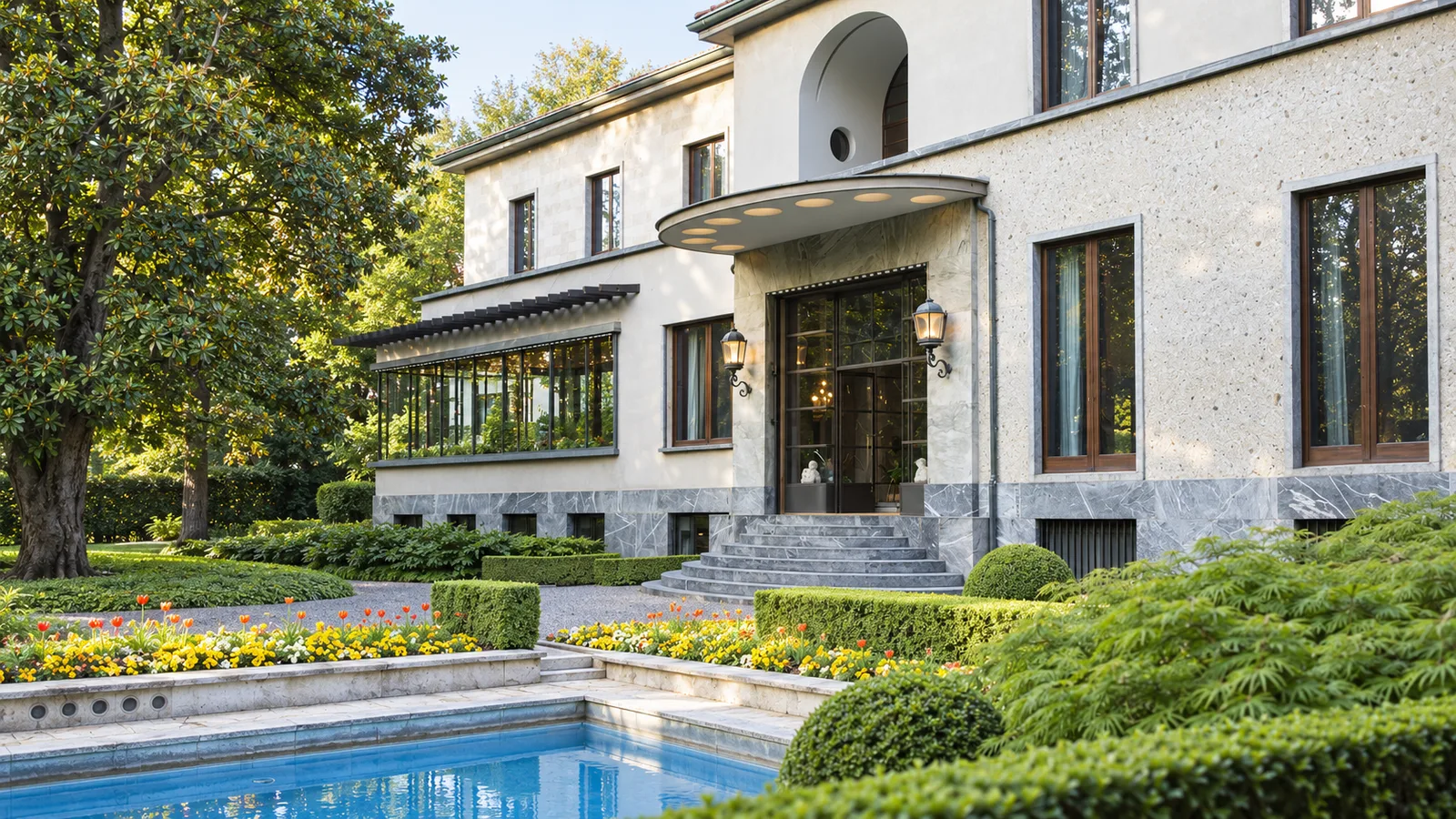
Villa Necchi Campiglio
Portaluppi’s 1930s house, with its veranda, geometric interiors and private-family art collections.
01 / The experience
Villa Necchi Campiglio
The veranda is the room that makes Villa Necchi Campiglio immediately recognisable: long windows draw the garden into a sage-green interior, while a curved sofa and bands of green marble turn the floor into part of the architecture. It is an elegant place to begin understanding a house where window frames, door mechanisms and furniture received as much attention as the façade. Beyond the gates on Via Mozart, the villa offers a remarkably complete picture of how a wealthy Milanese household lived in the 1930s.
Piero Portaluppi designed it between 1932 and 1935 for Angelo Campiglio, his wife Gigina Necchi and her sister Nedda. The family came from Pavia and industrial wealth: the Necchi name connects with sewing machines, while the Necchi-Campiglio business produced cast-iron goods. Their Milan home combined a garden, swimming pool and tennis court with such modern domestic infrastructure as an internal lift and service passages. The luxury lies as much in the way the house worked as in its expensive finishes.
The raised ground floor brings together the library, lounge, veranda, smoking room and dining room. These are connected social spaces, with changes of material and decoration marking different kinds of gathering. Portaluppi’s geometric language survives in ceilings and sliding doors, but the house also carries the taste of Tomaso Buzzi, who later introduced a more traditional decorative layer. Looking between the rooms reveals that conversation between modern design and aristocratic display.
In the veranda, the relationship with the garden is particularly deliberate. Green walls, upholstery and marble connect the interior with the planting outside, while the interlaced floor pattern gives the room a precise structure. Even the protective sliding doors became decorative objects: Portaluppi used alpacca, a nickel, zinc and copper alloy, rather than treating security as an awkward addition to the glass room. Chinese vases and a lapis-lazuli table add another layer to the family’s interest in objects from beyond Italy.
The dining room offers a different kind of richness. Parchment wall covering and the decorated ceiling preserve elements of the original scheme, while Brussels tapestries and Buzzi’s later furnishings change its character. Look above the table for the imaginative stucco world of animals, plants, stars and ships. Alfredo Ravasco’s elaborate centrepiece brings together coloured stones and coral; the windows connect this formal entertaining room with the pool outside.
Art is woven into the house rather than confined to one gallery. The Claudia Gian Ferrari collection includes early twentieth-century painting and sculpture, with Arturo Martini and Giorgio de Chirico among the names on the visitor route. Upstairs, the family bedrooms and marble bathrooms make the visit more intimate. The guest apartments also introduce the de’ Micheli collection of eighteenth-century art and decorative objects, and the Sforni collection of twentieth-century drawings. The shift from reception rooms to private rooms is an important part of the house’s appeal.
The garden completes the setting. Its pool and former tennis court belong to the history of a private home built around hospitality and sport. The pool is now a museum feature, with the villa’s windows and terraces explaining its relationship to the family’s daily life. After the density of the interiors, the planted grounds show how much space this household carved out within central Milan.
04 / Before you go
Plan your visit
Portaluppi’s 1930s house, with its veranda, geometric interiors and private-family art collections.
Cost
Paid admission
Select the current FAI admission category and any tour or exhibition inclusion.
When to visit
Use the villa’s dated visitor calendar.
Allow time for the house and garden; use the selected tour’s stated duration.
Getting there
Via Mozart 14, Milano
Use the operator’s visitor entrance at Via Mozart 14, Milano.
Plan your visit
Use FAI’s Villa Necchi visit and ticket options for your chosen date. Temporary exhibitions and special events have separate dates and may have different admission conditions.
Historic pool is part of the museum setting, not visitor swimming.
Location & nearby places
Continue exploring / Italian Grand Prix
More to explore
in Italian Grand Prix
Find another place for your itinerary, or explore all things to do in Italian Grand Prix.
 Spa & wellnessArmani/SPA MilanoExplore experience →
 Art, museums & Italian heritageMuseo Bagatti ValsecchiExplore experience →
 Theatre & performing artsTeatro Gerolamo · A miniature Milanese theatreExplore experience →
 Special-occasion Italian diningDon LisanderAffordable: counter food and pizza. Mid-range: trattorias and osterias. Special occasion: premium à la carte or tasting menus. Figures may describe a dish or a menu; see the stated basis.ItalianMilanese & LombardExplore experience →