Mareterra
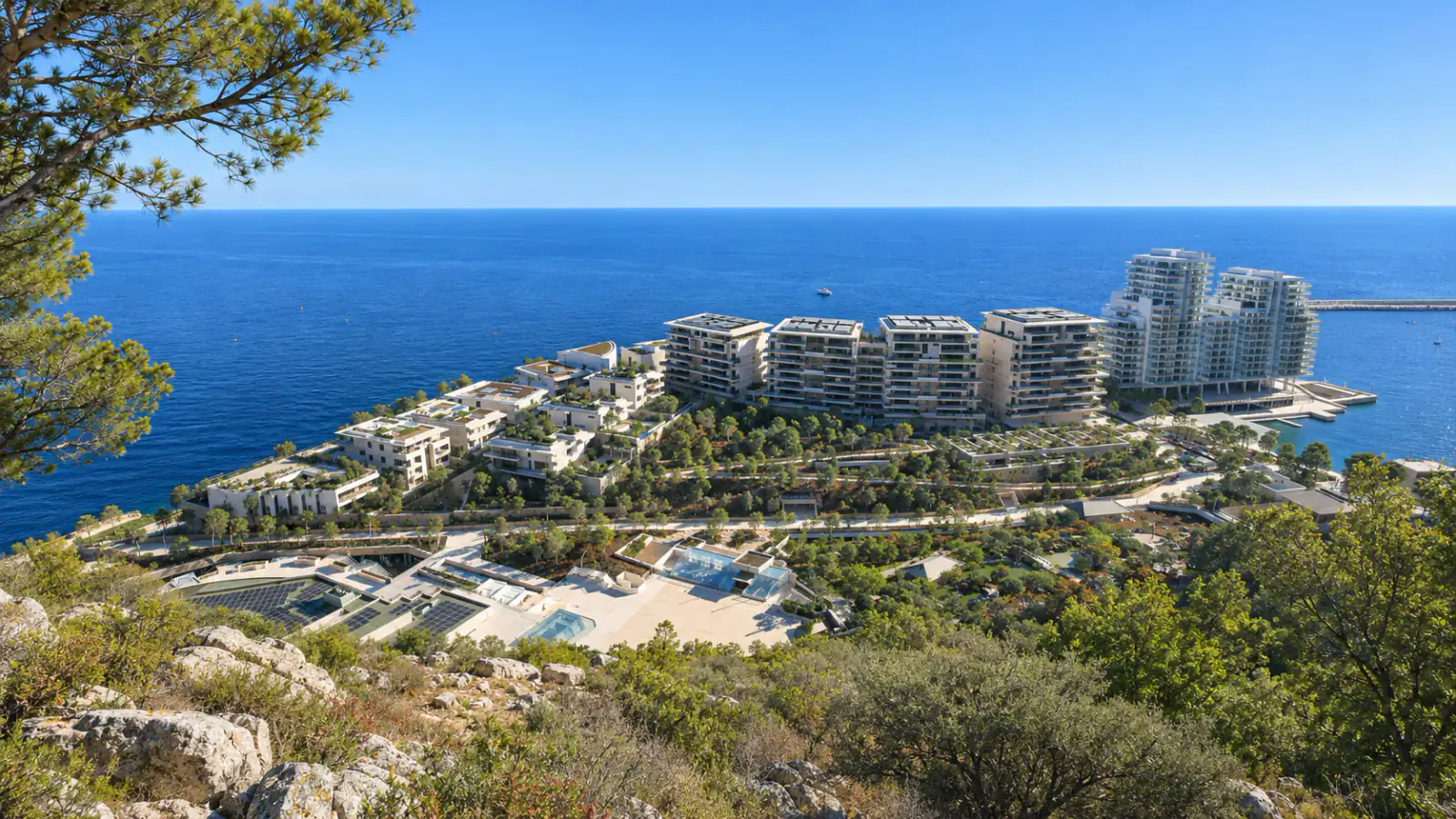
Six hectares of Monaco that did not exist before 2024, built on eighteen concrete caissons sunk into the Mediterranean — and about half of it is free public promenade, pine wood and square.
01 / The experience
Mareterra
Six hectares of ground that did not exist in 2013, half of it free public promenade, pine wood and square — with a sea wall designed to be lived on by fish and a Calder that waited sixty years to be installed properly.
The useful thing to know about Mareterra is that half of it is yours.
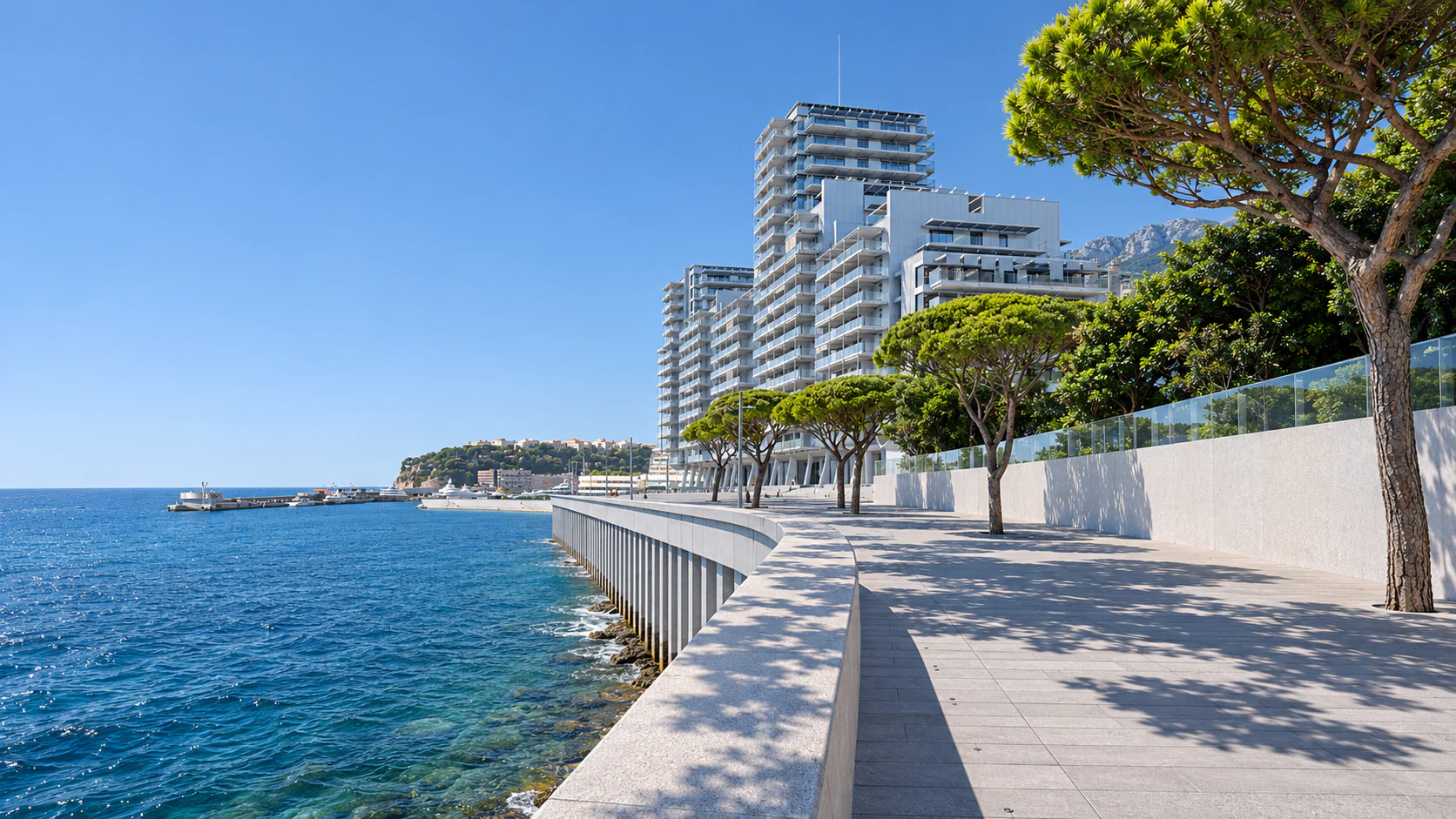
Every published account of this district is a property story — €2 billion, some of the most expensive apartments on earth. All true, and all beside the point if you just want to go for a walk. About three of its six hectares are free public pedestrian space: a 500-metre coastal promenade, a hectare of pine wood, gardens, five water basins, and a square with a major Alexander Calder sculpture standing above a reflecting pool. No ticket, no gate, no admission.
It is new enough that most guides have not caught up. Prince Albert II and Princess Charlene inaugurated it on 4 December 2024 and it opened to the public the next day. Work had begun in 2013, under the project name L'Anse du Portier — the bay it replaced — and older coverage still uses that name.
The engineering is the point, and you can go and look at it. The whole district stands on eighteen reinforced concrete caissons forming a belt against the sea, with sand filling the enclosure behind them. Their upper chambers, called Jarlan cells, are slotted so a wave passes in through vertical openings, spends its energy inside and comes back out weakened — absorbing the sea rather than resisting it. The concrete was deliberately moulded with grooves and relief so marine life would colonise it like a rocky seabed, and a nursery was built in to shelter fish larvae. La Grotte Bleue, on the Promenade du Prince Jacques, exists specifically so the public can see all this.
The best story here is the Calder. Quatre lances was made in 1964 for a reflecting pool at the Fondation Maeght and turned out too big to install. Monaco acquired it in 1966 at Princess Grace's wish; the Mediterranean wind wrecked the moving parts almost at once. It was displaced, re-erected at Fontvieille, taken down in 2007 and stored near Nice. On 4 December 2024 it went up on Place Princesse Gabriella — above a reflecting pool, framed by architecture, sixty years late and finally as its maker intended.
One thing to get right: Mareterra adjoins Larvotto and is not part of it. They share designers, which is why almost everyone merges them. Larvotto is the quarter with the free beach; Mareterra is the new ground beside it. Doing both in an afternoon is the obvious move, and neither costs anything.
Highlights
- 01
Six hectares of land extension — about 3% added to Monaco's territory — inaugurated by Prince Albert II and Princess Charlene on 4 December 2024, and open to the public the next day.
- 02
About half the district, roughly three hectares, is free public pedestrian space.
- 03
Work began in 2013 under the project name L'Anse du Portier, the bay it replaced, and cost about €2 billion.
- 04
It stands on eighteen giant reinforced concrete caissons, with the enclosure behind them filled with sand.
- 05
The Jarlan cells on top of each caisson are slotted so a wave passes in, loses its energy inside and returns weakened — absorbing the sea rather than resisting it.
- 06
The concrete was deliberately moulded with grooves and relief, and sanded in places, so marine life would colonise it like a rocky seabed; a nursery was built in for fish larvae and juveniles.
- 07
384 m² of protected Posidonia oceanica seagrass was lifted as entire sods, with sediment and roots intact, and replanted inside the Larvotto Marine Protected Area.
- 08
The masterplan is by Valode & Pistre; Renzo Piano Building Workshop did the Port district and Le Renzo; Michel Desvigne did the landscape; Foster + Partners, Stefano Boeri Architetti and Tadao Ando also contributed buildings.
- 09
Alexander Calder's Quatre lances, made in 1964 and too large for the Fondation Maeght commission it was made for, was raised on Place Princesse Gabriella on 4 December 2024 — above a reflecting pool, as Calder intended.
- 10
Public spaces include a 500-metre coastal promenade, about a hectare of pine wood at La Pinède, five water basins, a 16-berth marina, and La Grotte Bleue, a viewing point built so the public can see the caissons.
03 / The place
The building in context.
A story written in stone since 2013.
- Built
- 2013–2024; inaugurated 4 December 2024
- Architect
- Valode & Pistre (masterplan); Renzo Piano Building Workshop (Port district, Le Renzo); Michel Desvigne Paysagiste (landscape)
- Style
- Contemporary public realm on reclaimed land
04 / Before you go
Plan your visit
Prices & admission
Free. The promenade, the gardens, La Pinède, the squares, La Grotte Bleue and the meditation space cost nothing and are ungated. Shops and restaurants charge; the Grimaldi Forum next door charges per exhibition.
Opening hours
The promenades, gardens and squares are open ground with no gate, no ticket and no published hours. The meditation space is the one documented exception: generally open during the day, with its doors closed at night. Shops and restaurants keep their own hours, which are not published as a district. Nothing here is seasonal and nothing closes for the season.
Plan your experience
Nothing here requires booking and nothing charges admission. The public spaces are open ground with no published opening hours; the meditation space is the one documented exception, generally open in daylight with its doors closed at night. Guided tours have run in seasons — free tours by Monaco's Direction de l'Aménagement Urbain, no booking needed, and the Institut du Patrimoine's ticketed 'Au Cœur de Monaco' summer programme booked via culture.mc. IMPORTANT: both set their dates fresh each year, so check before planning around either.
Accessibility
On the evidence, probably the most accessible ground in Monaco — and almost none of the detail is published.
Location & nearby places
Continue exploring / Monaco
More to explore
in Monaco
Find another place for your itinerary, or explore all things to do in Monaco.
 Restaurants & fine diningCipriani Monte-CarloExplore experience →
 Restaurants & fine diningSong QiExplore experience →
 Bars & nightlifeThe Pub at Trinity MonacoExplore experience →
 Gardens & outdoorsJardin Japonais de MonacoExplore experience →
Good to know
Mareterra: frequently asked questions
Can the public go into Mareterra in Monaco?
Around half of Mareterra in Monaco, roughly three of its six hectares, is free public pedestrian space. Explore the coastal promenade, gardens, pine wood, squares, La Grotte Bleue and the meditation space. Residential areas are private.
Is Mareterra in Monaco free to visit?
The public spaces at Mareterra in Monaco are free and require no ticket or booking. Shops and restaurants charge, as does the neighbouring Grimaldi Forum for exhibitions.
What are the opening hours of the public spaces at Mareterra in Monaco?
The public spaces at Mareterra in Monaco are open ground with no published closing time. The meditation space generally opens during the day and closes at night.
When did Mareterra open?
Prince Albert II and Princess Charlene inaugurated Mareterra on 4 December 2024. The district opened to the public on 5 December 2024; work began in 2013.
Is Mareterra the same district as Larvotto in Monaco?
Larvotto is the Monaco quarter with the free public beach and Japanese Garden. Mareterra is the adjoining land extension, opened in 2024. Renzo Piano Building Workshop and Michel Desvigne worked on both.
Is Mareterra in Monaco an artificial island?
No. Mareterra in Monaco is a land extension attached to the coast. It was built using eighteen reinforced concrete caissons, with the enclosure behind them filled with sand.
What is the sculpture in the square at Mareterra in Monaco?
Alexander Calder’s Quatre lances, made in 1964, stands above a reflecting pool on Place Princesse Gabriella at Mareterra in Monaco. It was commissioned for a pool at the Fondation Maeght but was too large to install. Monaco acquired it in 1966 at Princess Grace’s wish. After wind damage, relocations and years in storage, it was raised in Mareterra on 4 December 2024.
What is La Grotte Bleue at Mareterra in Monaco?
La Grotte Bleue is a free viewing point on Promenade du Prince Jacques at Mareterra in Monaco. It reveals the concrete caissons that support the district.
How long should I allow for Mareterra in Monaco?
Allow about an hour to walk around Mareterra in Monaco, or two hours with stops. A visit combined with Larvotto can fill half a day.
How do I get to Mareterra in Monaco?
Mareterra is at the eastern end of Monaco, off Avenue Princesse Grace. From Monaco–Monte-Carlo station, use the lower exit at Sainte-Dévote; the upper exit serves Place du Casino. Buses 5 and 6 serve the nearby Grimaldi Forum. The district has 160 parking spaces.
What was Mareterra in Monaco called during construction?
Mareterra in Monaco was called L’Anse du Portier during construction, after the bay it replaced. Older documents and coverage use that name.