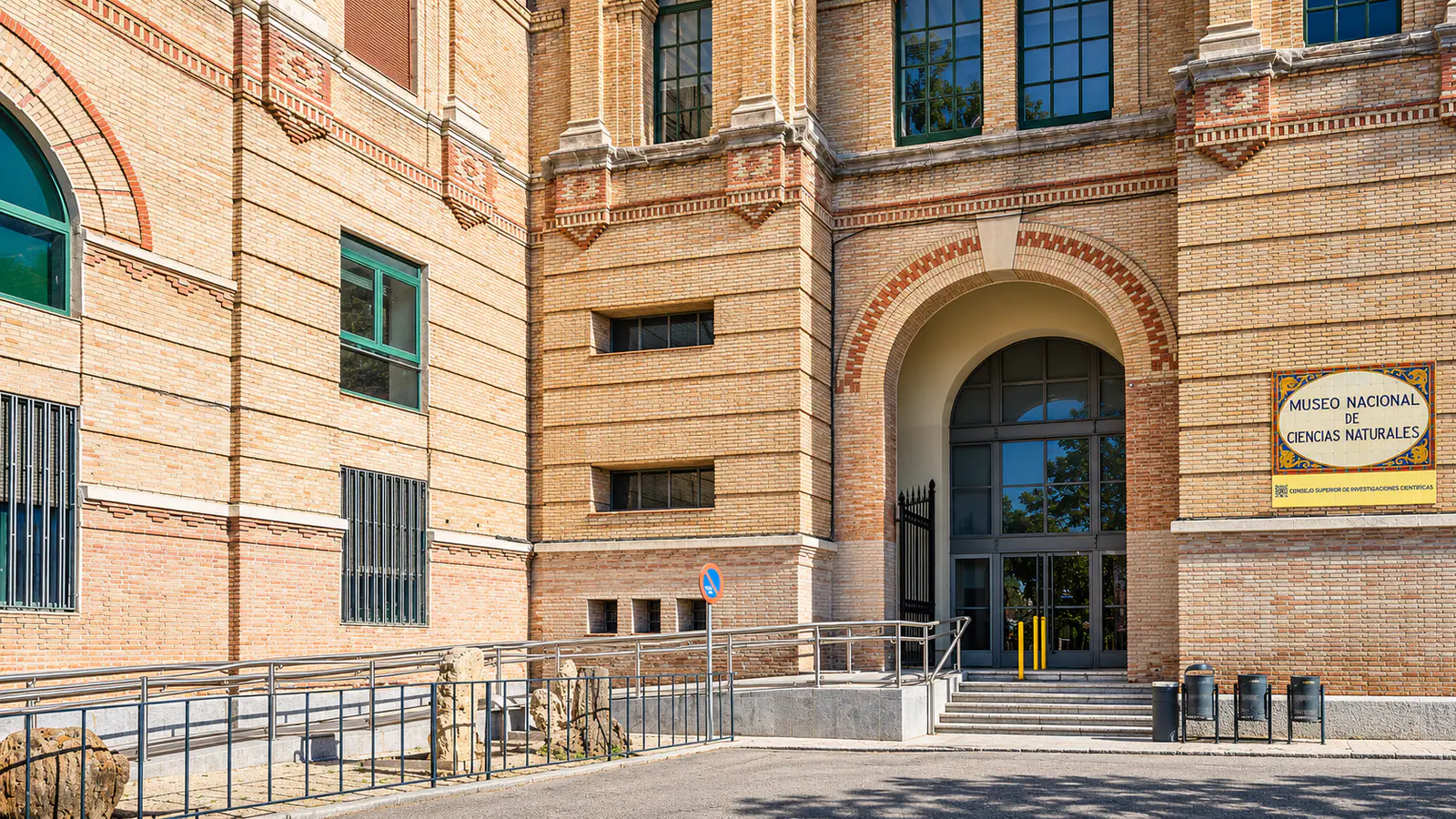
National Museum of Natural Sciences
See a Diplodocus cast, a giant ground sloth and mineral specimens near the Castellana.
01 / The experience
National Museum of Natural Sciences
A Diplodocus skeleton stretches through the fossil gallery, with its long tail and neck giving the room much of its scale. The museum’s skeleton is a cast of Dippy from the Carnegie Museum of Natural History. Nearby, a giant ground sloth from Luján, Argentina, takes the story forward into the age of large mammals. These two specimens alone make a useful starting point for children asking how extinct animals stood, moved and fed.
In the minerals cases, look for the yellow sulfur crystals from Conil de la Frontera. They came into the collection during the era of the Royal Cabinet of Natural History, a different thread from the life-size reconstructions and fossil skeletons. The biodiversity displays give you a second route through the museum. Choose a gallery or two if you have a race-day transfer or a timed meal waiting after the visit.
The building is close to the Castellana and the Gregorio Marañón interchange. It suits a short family visit from the hotel bases north of the centre. For race week, use the early opening: the usual summer timetable runs through 14 September and ends mid-afternoon.
04 / Before you go
Plan your visit
Admission
€7 per adult. €3.50 for children aged 4–18. Under 4s free.
Race-week opening pattern
From 1 July to 14 September, Tuesday–Sunday 10:00–15:00. Closed Monday except holidays.
Getting there
Calle de José Gutiérrez Abascal 2, Madrid
Use Gregorio Marañón on Metro Lines 7 or 10 and look for the brick museum building off the Castellana.
Museum admission
Use the ticket link on the museum site or buy at the ticket office. Arrive at the time shown if you buy online. The free Tuesday and Sunday afternoon windows pause in the summer timetable.
Location & nearby places
Continue exploring / Madrid during F1
More to explore
in Madrid during F1
Find another place for your itinerary, or explore all things to do in Madrid during F1.
 Fine DiningCoqueExplore experience →
 Stadium tours & sportTour Bernabéu and Real Madrid MuseumExplore experience →NeighbourhoodsCastellana and ChamartínExplore experience →
 NeighbourhoodsChamberíExplore experience →
Good to know
National Museum of Natural Sciences: frequently asked questions
Is the large Diplodocus an original skeleton?
It is a cast of the Carnegie Museum’s Diplodocus. The fossil and minerals exhibition also includes the giant ground sloth from Luján.