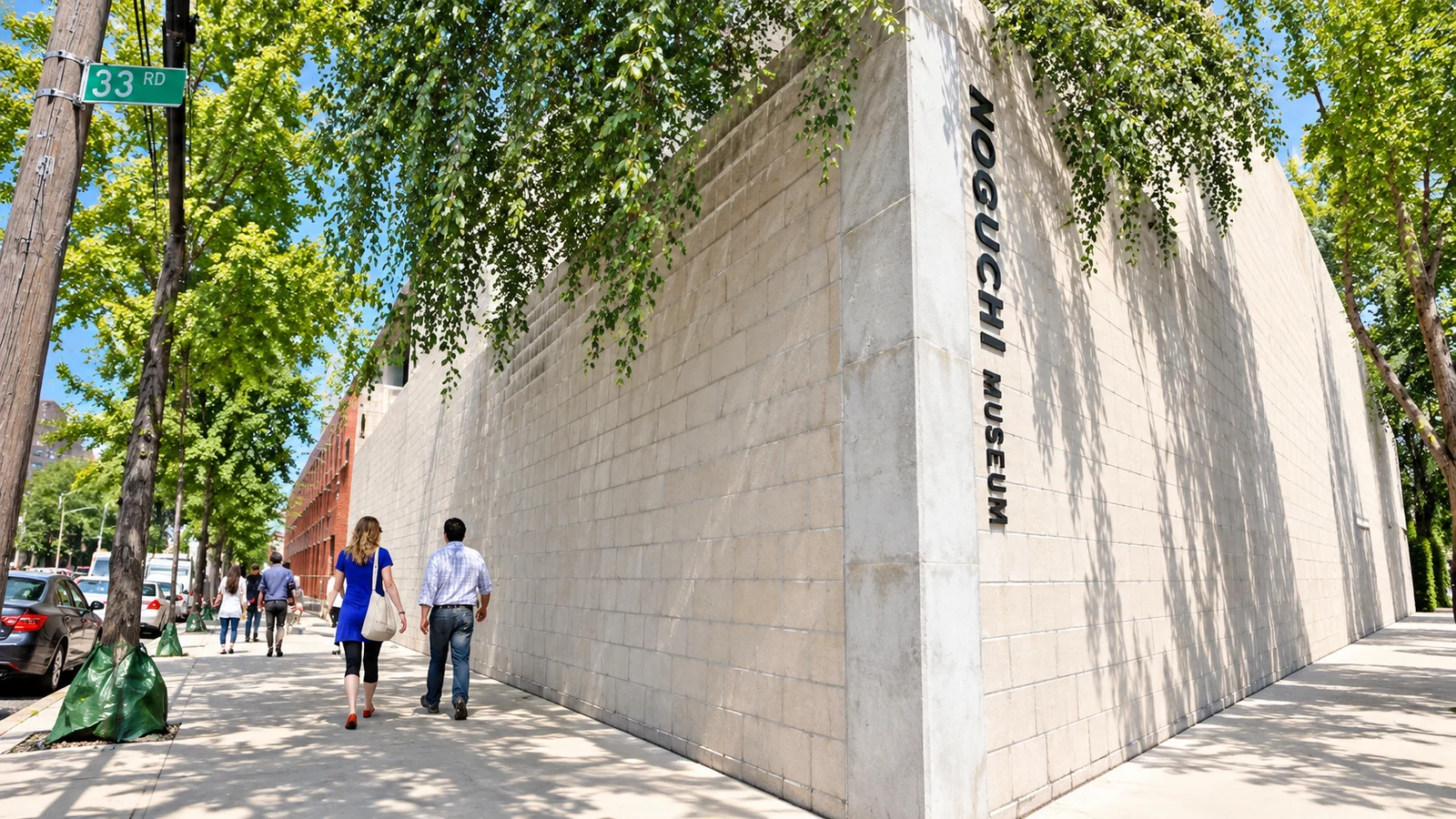
The Noguchi Museum
Isamu Noguchi’s sculpture, gallery spaces and outdoor garden in Queens.
01 / The experience
One artist’s sculptures, garden and way of shaping space.
Isamu Noguchi’s sculpture, gallery spaces and outdoor garden in Queens.
The Noguchi Museum gives a Queens art day a clear, focused subject: the work of Isamu Noguchi in a setting he founded and designed. Galleries, the indoor-outdoor pavilion and the sculpture garden make space part of the experience. Choose it when you want to spend time with one artist’s ideas rather than cover a broad sequence of art history.
The Well (Variation on a Tsukubai) brings basalt and water into the same sculpture. It is a clear example of how Noguchi made the relationship between materials part of the work. Elsewhere, a rough surface, a worked edge or a space beneath a form can matter as much as the outline. The garden places those relationships within a living outdoor setting.
The galleries add other scales and contexts for Noguchi’s practice. His work extends across sculpture and designed environments, with changing installations determining the particular works you will encounter. Choose the open collection areas and exhibition route for the day rather than expecting one permanent arrangement on every floor.
The museum shop gives a related view of that wider practice through Akari light sculptures, furniture and publications. It is useful for understanding how Noguchi’s ideas entered domestic life as well as gardens and exhibition spaces. A shop display is a separate part of the visit, not a promise that a particular museum work is on sale.
Make this the main cultural visit or pair it with a Queens meal. Museum of the Moving Image is another substantial museum in the wider Astoria area, while PS1 is farther south in Long Island City. Those are separate journeys. Noguchi’s smaller, single-artist focus can be a welcome contrast without requiring a second museum to complete the afternoon.
In pictures
Arrival and sculpture.
In pictures
Stone, light and garden.
In pictures
Design and the galleries.
Highlights
- 01
Isamu Noguchi sculpture
- 02
Artist-designed museum
- 03
Outdoor sculpture garden
04 / Before you go
Plan your visit
Allow about 100 minutes, plus travel.
Admission & spending
General admission $16; seniors 65+ and students $6; children under 12 free. First Friday admission is free.
Tickets & visit detailsWhen to visit
Wed–Sun 11:00–18:00; last admission 17:30. Closed Mon–Tue. First Fridays May–September extend to 20:00.
Arrive
Broadway · N/W. Walk west along Broadway towards Vernon Boulevard, then south to the museum at 9-01 33rd Road. The Q103 on Vernon Boulevard is an alternative to the longer walk. Broadway station's stair approach is not a step-free route.
9-01 33rd Road, New York, NY
Journey times are estimates for ordinary daytime service, including the street approach. Add security, queues and any ferry or tram crossing separately. For a step-free journey, choose suitable stations and operating lifts; these routes are not an accessibility guarantee.
Plan your visit
The current policy is walk-up ticket purchase, without advance reservations. A free first Friday does not require a reservation; exhibitions and access to particular spaces can change during installation.
Accessibility
The museum offers wheelchair access, a loan wheelchair and portable seating. The gallery and garden routes have distinct surfaces.
Location & nearby places
06 / Good to know
The Noguchi Museum: frequently asked questions
01What makes this visit worthwhile?
Isamu Noguchi’s sculpture, gallery spaces and outdoor garden in Queens. Highlights include Isamu Noguchi sculpture, Artist-designed museum, Outdoor sculpture garden.
02What does admission include?
General admission $16; seniors 65+ and students $6; children under 12 free. First Friday admission is free.
03How do I arrive?
Broadway · N/W. Walk west along Broadway towards Vernon Boulevard, then south to the museum at 9-01 33rd Road. The Q103 on Vernon Boulevard is an alternative to the longer walk. Broadway station's stair approach is not a step-free route.
04What access arrangements matter?
The museum offers wheelchair access, a loan wheelchair and portable seating. The gallery and garden routes have distinct surfaces.