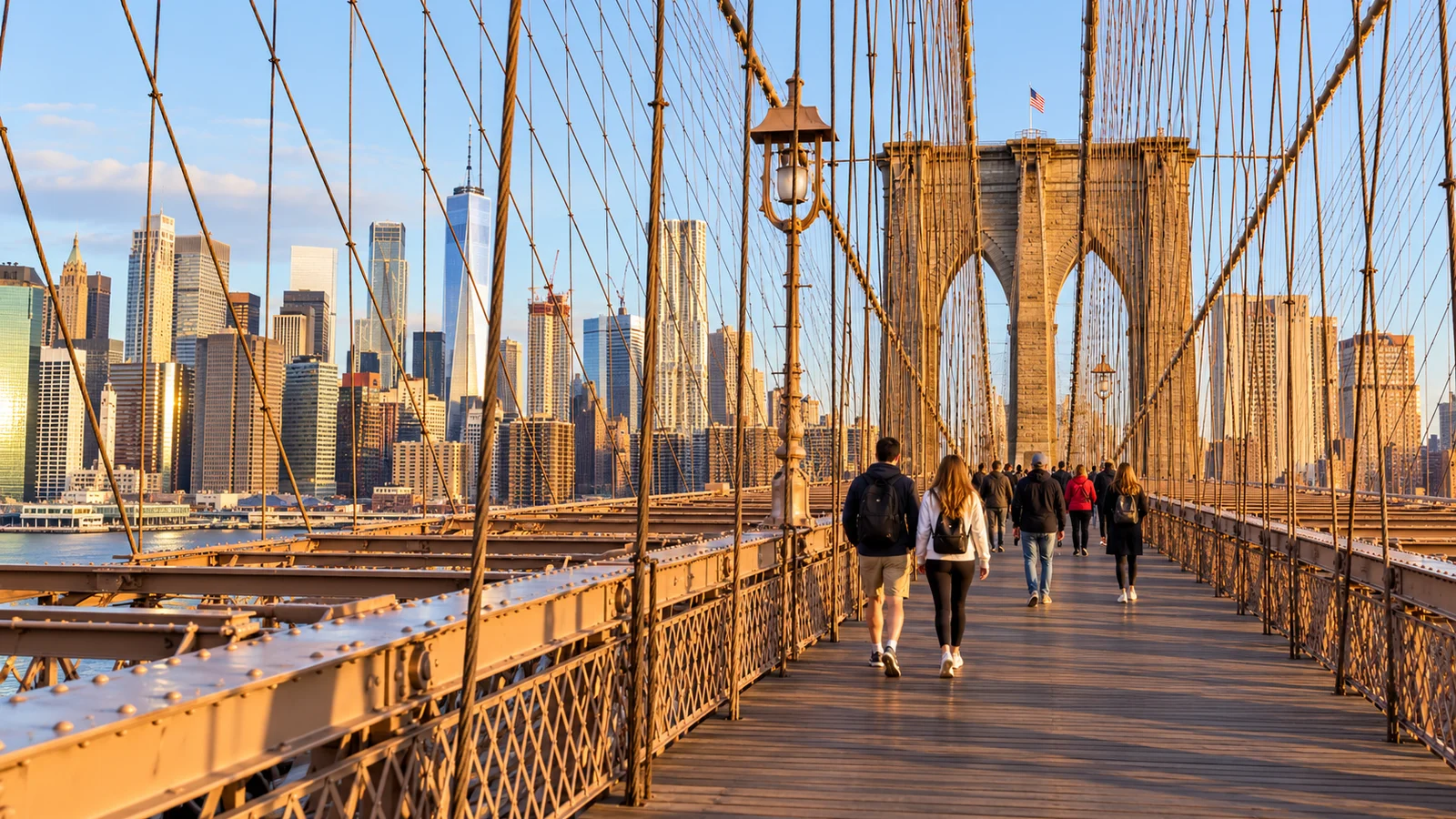
Brooklyn Bridge pedestrian walk
Walk the raised pedestrian deck through the bridge’s stone towers and suspension cables.
01 / The experience
Walk through the stone towers and the geometry of the cables.
Walk the raised pedestrian deck through the bridge’s stone towers and suspension cables.
Brooklyn Bridge is a walk inside a landmark. The stone arches, raised pedestrian promenade and suspension cables form the foreground to the skyline, so the crossing offers more than the view from one riverbank. Moving towards a tower and then beyond it changes the way the structure and city overlap.
Completed in 1883, the bridge connected Manhattan and Brooklyn across the East River at a scale that made it an engineering landmark. Look at the relationship between the heavy masonry towers and the much finer cables. The deck is a route through a working piece of infrastructure, with road traffic and a separate protected cycle path forming other parts of the bridge.
Choose your direction for the walk you want. Starting in Manhattan gives the stone portals a strong sense of approach; returning towards Manhattan brings the skyline in front of you for much of the crossing. A one-way walk has the practical advantage of avoiding repetition, provided you have decided what happens on the other bank.
The Manhattan pedestrian approach is at Park Row and Centre Street, opposite City Hall Park. Use the proper approach rather than a point on the water or a road ramp. The bridge slopes inland at both ends, so the experience includes more than the distance directly over the river.
A bridge walk can be the outdoor part of a Lower Manhattan day, but it is not walking transport straight to Lucali in Carroll Gardens or Aska in Williamsburg. Those are separate Brooklyn journeys. Sun, wind and crowds also change the pace of the crossing; leave the next timed booking far enough away that the bridge can remain a walk rather than a rush.
In pictures
Crossing the East River.
In pictures
The bridge and Brooklyn landing.
In pictures
Continue along the waterfront.
Highlights
- 01
Raised pedestrian deck
- 02
Stone towers and cables
- 03
Manhattan–Brooklyn crossing
04 / Before you go
Plan your visit
Allow about 100 minutes, plus travel.
Admission & spending
Free pedestrian crossing. A guided tour is optional.
Tickets & visit detailsWhen to visit
Flexible outdoor crossing with no ticketed entry slots. Daylight gives clearer harbour views; follow any temporary promenade restrictions.
Arrive
Brooklyn Bridge–City Hall · 4/5/6. Start at the Manhattan pedestrian approach by Park Row and Centre Street. In Brooklyn, use the Tillary Street and Boerum Place approach for a route without the narrow staircase. These estimates reach the Manhattan start; allow another 45–60 minutes for the crossing and photographs.
Manhattan approach at Park Row and Centre Street, New York, NY
Journey times are estimates for ordinary daytime service, including the street approach. Add security, queues and any ferry or tram crossing separately. For a step-free journey, choose suitable stations and operating lifts; these routes are not an accessibility guarantee.
Plan your visit
No reservation for a self-guided walk. Allow 45–60 minutes for a one-way crossing with photo stops; keep to the pedestrian promenade and use the street-level ramps if avoiding stairs.
Accessibility
Use the long approach paths rather than a stair entrance when avoiding steps. Allow for gradients, crowds and an exposed crossing.
Location & nearby places
06 / Good to know
Brooklyn Bridge pedestrian walk: frequently asked questions
01What makes this visit worthwhile?
Walk the raised pedestrian deck through the bridge’s stone towers and suspension cables. Highlights include Raised pedestrian deck, Stone towers and cables, Manhattan–Brooklyn crossing.
02What does admission include?
Free pedestrian crossing. A guided tour is optional.
03How do I arrive?
Brooklyn Bridge–City Hall · 4/5/6. Start at the Manhattan pedestrian approach by Park Row and Centre Street. In Brooklyn, use the Tillary Street and Boerum Place approach for a route without the narrow staircase. These estimates reach the Manhattan start; allow another 45–60 minutes for the crossing and photographs.
04What access arrangements matter?
Use the long approach paths rather than a stair entrance when avoiding steps. Allow for gradients, crowds and an exposed crossing.