Tree of Life
Walk around Bahrain’s centuries-old desert tree and discover the late Islamic settlement found around it.
01 / The experience
One living landmark, with a settlement beneath its story.
A striking desert landscape with a documented archaeological story beyond the tree’s longevity.
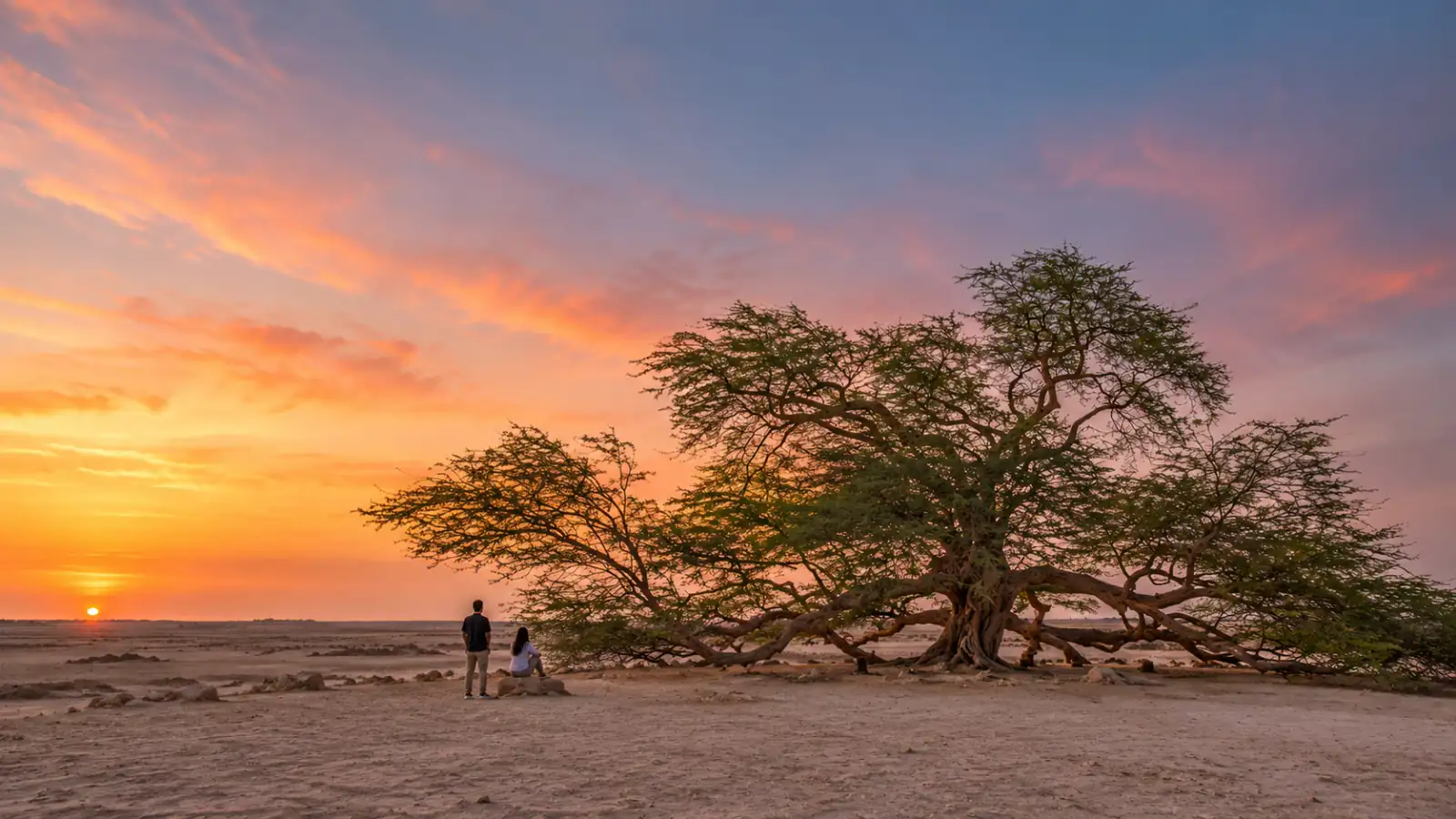
The Tree of Life spreads sideways as much as it rises. Its heavy, twisting branches form a broad green canopy above a low sandy hill in southern Bahrain, with the surrounding open ground making the tree’s scale easy to read. The most revealing view is the whole relationship between canopy, trunk and landscape: a living landmark set within an archaeological site, rather than simply a tree photographed against an empty sky.
Bahrain’s Culture Authority traces its age to a study carried out in 1986, which placed its planting around 1583. The question of how it finds enough moisture to survive in such a dry setting remains part of its appeal. The green canopy is all the more striking against the exposed ground around it.
The ground around the tree adds a less familiar story. Excavations in 2010 identified a settlement from the late Islamic period, dated broadly to 1440–1640. Pottery included everyday vessels and imports from India and China, evidence that this apparently isolated location belonged to wider networks of movement and exchange. The remains were too poorly preserved for archaeologists to determine the settlement’s functions in detail. They are a useful reminder that today’s open landscape was not always without human occupation.
The visitor development changes how the landmark is approached. A circular protective boundary separates it from vehicles and creates a route around the tree, with interpretation connecting it to other culturally significant trees. The visitor centre and small outdoor performance area were developed as part of the site’s protection. Their low arrangement leaves the tree itself as the dominant feature; an occasional arts event is an additional use of the setting, rather than a regular performance promised with a visit.
A walk around the perimeter gives changing views of the low limbs and weathered trunk without needing to climb or approach exposed roots. Daylight is especially useful for seeing the surrounding landscape and the visitor-area layout. The site works as a focused southern Bahrain stop, with its own road journey and return pickup; a nearby circuit event can still change how much time that journey takes.
Highlights
- 01
Centuries-old tree in the southern desert
- 02
Late Islamic settlement excavated around the landmark
- 03
Protective perimeter and interpretive visitor area
- 04
A focused stop reached by road
04 / Before you go
Plan your visit
Walk around Bahrain’s centuries-old desert tree and discover the late Islamic settlement found around it.
Admission & costs
Ask about admission
Budget for return transport. Ask Bahrain Tourism about any current admission or event charges before travelling.
Visiting hours
Daily 06:00–22:00 for the visitor site. The visitor centre and any performances may have separate arrangements.
Getting there
Tree of Life, Sakhir desert, Bahrain
Follow the signed Tree of Life access road in the Sakhir desert near Jebel Dukhan. Arrange the return pickup with your driver before setting out.
Plan your visit
Use the official visitor information for the site. Arrange a return driver or use your own vehicle; ask separately about any organised event.
Accessibility
Ask Bahrain Tourism about current parking, ground surfaces and a continuous step-free route from vehicle arrival to the viewing perimeter.
Location & nearby places
Continue exploring / Bahrain
More to explore
in Bahrain
Find another place for your itinerary, or explore all things to do in Bahrain.
 Family attractionsJanat Dilmun WaterparkExplore experience →
 Adventure, active & sportBatelco Fitness on TrackExplore experience →
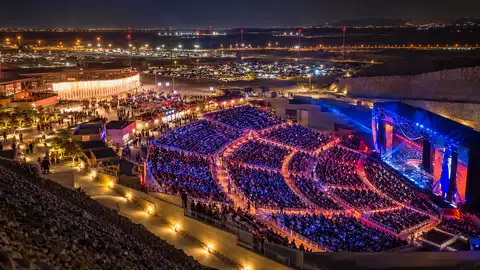 Concerts & entertainmentBeyon Al Dana AmphitheatreExplore experience →
 Wellness & spaRaffles Al Areen spa in BahrainExplore experience →
Good to know
Tree of Life: frequently asked questions
Where is Bahrain’s Tree of Life, and how do I get there?
Bahrain’s Tree of Life is in the Sakhir desert near Jebel Dukhan. Follow the signed access road by car or booked driver and arrange the return journey.
What are the Tree of Life’s opening hours in Bahrain?
Bahrain’s Tree of Life visitor site is listed as open daily, 06:00–22:00. Visitor-centre access and occasional performances can have separate arrangements.
How long does a visit to Bahrain’s Tree of Life take?
Allow 45–60 minutes at Bahrain’s Tree of Life, plus road travel. Daylight helps you see the tree, interpretation and surrounding desert.
Can I climb Bahrain’s Tree of Life?
At Bahrain’s Tree of Life, keep to the viewing route and avoid disturbing the roots. Climbing the tree is prohibited. The low branches are visible from the perimeter.
What else is there to see at Bahrain’s Tree of Life?
The Tree of Life visitor area in Bahrain connects the landmark with interpretation and the late Islamic settlement excavated around it. Outdoor performances are occasional, rather than a daily attraction.
Is Bahrain’s Tree of Life suitable for wheelchair users?
For wheelchair access to Bahrain’s Tree of Life, ask Bahrain Tourism about parking, ground surfaces and a continuous step-free route from the vehicle to the viewing perimeter.
Can I fit the Tree of Life between Bahrain Grand Prix sessions?
Treat Bahrain’s Tree of Life as a separate southern outing with a planned return. Race traffic and circuit access controls make a gap between sessions an unreliable visiting window.